Showing posts with label DfT. Show all posts

Friday, August 23, 2013

Weighty Matters

During the past 40 years, the Department for Transport (DfT) has gained a wealth of experience in the art of data manipulation and disinformation when conducting official investigations into fishing vessel casualties, especially those in which dubious stability was thought to be a factor in their loss. This expertise is currently being used quite blatantly by the DfT (via MAIB) to both cover their own backs and safeguard the interests of their many business ‘clients’.

Generally, the DfT only feels threatened when it has made a mistake - when there is something it did not do, that it should have done or it did something that it should not have done - and lives were subsequently lost at sea.

In the case of the FV Gaul, the DfT approved her stability (see copy of the stability certificate below), for unlimited operation at sea, just 14 month’s before the trawler capsized and sank (in February 1974), with the loss of 36 lives.


Following the loss of the Gaul, the official investigation, led by the DfT, was quick to put on record that the Gaul had met the IMCO minimum stability standards for deep-sea trawlers “with a substantial margin”. 

In our posts of 1 January 2010 [LINK] and 8 February 2010 [LINK] we were able to point out that this official statement was, in fact, incorrect and we gave details of the Gaul’s ‘arrival in Port’ and preceding sailing conditions where the IMCO minimum stability standards were not and could not be met. 

Trident 
 
In our post of 4 August 2010 [LINK] we also described how the stability records for the calculated lightship and sailing conditions of the Trident, which capsized and sank in 1974, with the loss of 7 lives, were callously modified by the Trident RFI experts (hired and paid for by the DfT) to give credence to the “official” view that, at the time of her loss, the Trident substantially met the IMCO stability standards of the day – an official requirement for grant-aided fishing vessel purchases in the early 1970s. 

We also noted in our posts of 28th February [LINK] and 27th April 2011 [LINK] that considerable sums of money had been squandered on worthless model tests, which were deliberately fed with doctored data, to give the results that our officials desired [1]

This blatant deception was only attempted because, contrary to official policies, the Trident’s lightship particulars (and stability reserves) had not been accurately established and verified [2] at the time that she was built. 

Gaul 

The Gaul’s lightship particulars (and stability reserves) were also left unverified when she was built [3], the data used being merely a copy of those derived from the inclining experiment, held in February 1972, on the Ranger Calliope (subsequently re-named Arab).

Testimony by Mr M. Scott (DfT surveyor) - 1974 Formal investigation into the loss of the Gaul - Day 12 page 27 : 


Surprisingly, if you check out the lightweight figures in the footnote below [4] you can see that an additional 11 tons of solid ballast has somehow managed to make its way into the calculations of the DfT, the shipyard and the Owner’s Consultants. When their investigations into Gaul’s stability were put in hand for the 1974 inquiry, it became an integral, unspecified part of the Gaul’s lightship weight. 

This 11 tons of notional ballast was useful in subsequent calculations in that it lowered the Gaul’s vertical centre of gravity (by 180 mm) - and would therefore be readily adopted by those who did not wish the tag of ‘deficient stability’ to be linked to the Gaul’s loss. Nonetheless, at the original FI hearings, the Builders, Brooke Marine, the Owner’s consultants, Y-ard and the DfT all managed to imply that solid ballast was not necessary on the Gaul to meet the IMCO minimum stability requirements (see below):

Mr M. Scott (DfT) - transcripts day 12 page 45 

Mr G. Donaldson (Brooke Marine) transcripts day 9 page 67
 
Mr A. Gilfillan (Y-ard) transcripts day 11 page 43 – in proposing improvements for Gaul’s 3 remaining sister vessels: 


This notional ballast was also an integral but invisible part of the Gaul’s lightship weight during the subsequent lengthy and expensive testing carried out by Morral in the late 1970s at the National Maritime Institute. This was another instance in which taxpayer’s money was spent on extensive model testing, but in which the basic data was skewed, to give the results that our officials desired. 

If we exclude this 11 tons of phantom ballast (it was not present on the Gaul) from the Gaul’s lightship and then check out her reserves of stability, we can see that this was degraded to the point where she did not meet the IMCO minimum stability criteria on arrival at distant fishing grounds. Furthermore, if she then did not proceed to promptly fill her fish hold with a significant catch of fish, she would be unable to meet the IMCO minimum stability standard throughout the rest of her voyage!

_______________________________________________________

[1] In 2005 the DfT also deliberately destroyed a number of folders of evidence and video that was unfavourable to their desired outcome.

[2] Neither an inclining experiment nor lightship check was carried out on the Trident. 

[3] The Gaul’s lightship data (displacement & vertical and longitudinal centres of gravity) were not obtained from a unique inclining experiment; they were copied instead from an inclining experiment held on the Ranger Calliope (a sister to the Gaul) on 1 February 1972; however, a simple lightweight check, to verify the integrity of the copied data, was not carried out on the Gaul. 

[4] Lightship data obtained from the inclining test on the Ranger Calliope
Displacement = 1099.63 tons, 
Vertical centre of gravity = 20.2 ft above base 
Longitudinal centre of gravity = 9.46 ft aft Midships 
Gaul Lightship data - used for all official stability investigations: 
Displacement = 1110.6 tons, 
Vertical centre of gravity = 20.02 ft above base 
Longitudinal centre of gravity = 9.99 ft aft Midships

Thursday, November 24, 2011

Another whistleblower

Apart from the naval architect whose disclosures have been published on this blog over the last five years, the Department for Transport, the Maritime and Coastguard Agency more precisely, were blessed with another whistleblower. The latter, Mr Jayan Pillai, an article in the Private Eye (see below) informs us, raised concerns about the MCA’s flexible approach towards the registration of ships with fire-fighting arrangements that fell short of the international seagoing safety standards.

The Department has not owned up to anything yet and has decided to fight them both - a move, which, we suspect, is going to be associated with a lot of mess.

 (article c/o Private Eye, No.1300, 28 October 2011)

The DfT/MCA, it seems, have made rather a hobby of plastering over the cracks, and, although in a small MCA branch there once existed two whistleblowers, within the organisation itself, there is certainly scope for many more.

Tuesday, October 25, 2011

Export Goods

Nobody enjoys reminiscing about an old acquaintance as much as I do – especially when the acquaintance in question played an important role in the Department for Transport under the last Labour regime.

The legal proceedings that we started against the government – referred to in our previous posts – came to a stage when witness testimonies were called for and, as the whole action hinged upon our disclosures about the Gaul, the Derbyshire and the Trident investigations, we thought it beneficial to ask the Head of Shipping Policy in the DfT, Mrs Theresa Crossley, to contribute her inside knowledge to the case. (You will remember Mrs Crossley as the official who answered our more recent Freedom of Information requests in respect of the Derbyshire RFI.)

Well, to our disappointment and surprise, when we looked for her, we found that she was no longer there - she had been exported to Lisbon. Yes, as the March 2010 copy of the European Maritime Safety Agency’s newsletter informs us, on 16 February 2010, Theresa Crossley was amply rewarded with an appointment as head of the Department ‘B’, ‘Implementation’, in EMSA. That made our witness, from the UK legal action point of view, out of reach. We offered to pay her costs to either come to the UK or give a sworn statement from Lisbon, but were refused point blank. This was really a pity, given her tenure of the DfT key management post all through the turbulent years of the Gaul and the Trident RFIs. Just like us, Mrs Crossley knows very well where the whitened bones of the murdered formal investigations lay buried.  Amongst other similarly serious matters. Unlike us, she's not going to make a full disclosure.


It seems that EMSA has a penchant for collecting UK personnel with knowledge about the miscarriages of justice perpetrated under Labour. Is this pure coincidence or is it something akin to a collector’s fascination with artefacts of the past?

(More to come)

Sunday, August 21, 2011

Sufficient for the DfT

Following on from our post of 1 August 2011, which referred to the Trident families’ FOI request addressed to the DfT, the search for the missing video footage of the NMI model tests on FV Trident continues [LINK]. However, the DfT, as solicitous as ever, appear to think that a couple of blurred snapshots taken from the 1976 cine film should be sufficient to satisfy anyone who has the audacity to be interested in that research:

Part of the DfT letter dated 19 August 2011

We beg to differ and consider that the comments made by Professor Dahle, in the written discussion that followed the formal presentation of this research at RINA in 1979, show both the importance and the relevance of this research to the investigation into the loss of the Trident:

Comments by Professor Dahle cited in Tony Morrall’s 1979 paper

(More to come)

Monday, August 01, 2011

Confirmation bias

In 1975 in the aftermath of the Gaul and Trident disasters the Department of Trade decided to sponsor a program of research at the National Physical Laboratory (NPL), to try and discover why two well found fishing vessels had suddenly capsized and sank with significant loss of life. This research would focus on stability issues and would be carried out by the ship division of the NPL (subsequently renamed the National Maritime Institute, NMI), one of the world’s leading maritime test establishments at that time.


Scale models of the Gaul and the Trident hulls were then built and subjected to a program of sea keeping tests in waves of varying magnitude; their behaviour in different conditions was filmed, documented and analysed. Unfortunately, the outcome from this research was initially kept under wraps by the DOT, until, in 1979-80, Dr Tony Morrall (NMI) was allowed to publish two brief technical papers, through the Royal Institution of Naval Architects. The two papers gave an edited overview of the NMI’s research/conclusions for the two vessels and video footage from the NMI tests was shown, although the identity of the Trident was concealed:
  1. ‘Capsizing of small trawlers’ published at a RINA meeting in Glasgow on February 20 1979 (N.B. The Trident was not identified within this report; it was merely referred to as ‘trawler A’)
  1. ‘The Gaul disaster: an investigation into the loss of a Large Stern Trawler’ -  published at a RINA meeting in London on April 15 1980
In brief, the conclusion from the NMI research about the loss of the Trident was that she had capsized in moderate sea conditions because she had insufficient stability, while the conclusion about the loss of the Gaul was that she had capsized because of severe weather conditions in conjunction with some unknown circumstance such as internal flooding, which had degraded her inherent stability reserves. [1]

Following the discovery of both wrecks and the decision to re-open both formal investigations (RFI), the DfT’s experts dusted down and sifted through the NMI’s research folders and decided that:
  • The NMI research data on the loss of the Gaul, had yielded the ‘right’ answers, as far as the DfT was concerned, and therefore could be utilised as evidence during the Gaul RFI. In fact in their marine accident report no. 4/99, the MAIB went as far as praising the NMI’s research as being “a comprehensive and ambitious project lasting two and a half years”. Video footage of the NMI tests together with the Morrall research paper were considered to be new and important evidence for the purposes of the Gaul RFI hearings in 2004
  •  Unfortunately, the NMI research data on the loss of the Trident (which had an identical pedigree to that of the Gaul) had yielded the ‘wrong’ answers, as far as the DfT was concerned, and was therefore deemed to be unsuitable for a public airing or disclosure during the Trident RFI.
Thereafter, in 2005 the DfT allegedly shredded the Trident research folders and in the RFI hearings of 2010, the Advocate General and her experts together with the Aberdeen Sheriff summarily dismissed the NMI research data (see below):

Pages 188-90 Trident RFI - transcripts of evidence 12/7/2010:

The above exchanges between Mr Thomson, the counsel for the Trident families, and Sheriff Young, where rational argument is being summarily dismissed by ridicule, do not cast the Sheriff in a favourable light.

While the DfT and its associates have been keen to disregard and discard the Trident’s NMI research data with its inconvenient conclusion regarding stability, the Trident families have not, as yet, been convinced [LINK] by this official obfuscation.

---------------------------------------------------------------
[1] In our posts of 1 January 2010 and 8 February 2010 we revealed that the DOT/Owners had estimated the Gaul’s stability reserves for her last voyage to be greater than was reasonably justifiable. This ‘enhanced’ level of stability was also specified by the DOT for the model used in the Gaul NMI tests, the test results would undoubtedly have been influenced by this factor.

Friday, July 01, 2011

Balancing commercial interests with safety

“DfT seeks to ensure that the UK shipping industry remains a major player globally…and that the UK balances commercial interests with safety”  –    http://www.dft.gov.uk/shipping/

In our posts of 1 Jan 2010 and 8 Feb 2010 we discussed how the stability of the Gaul had been adversely affected by modifications to two of her double bottom seawater ballast tanks - modifications carried out by the Gaul’s owners to enable her to carry more fuel oil and thus be able to spend more time fishing at sea. The modifications were performed after her delivery from Brooke Marine in 1972, when she was named Ranger Castor, before she was sold on to British United Trawlers (Hellyer Brothers) and renamed the Gaul.

We also mentioned that during the original public inquiry of 1974, the DOT (now DfT) went to great lengths to ensure that the Gaul’s stability deficiencies, which resulted from these tank modifications, did not become the focus of the public inquiry. We suggested in our posts that, because of the errors they had made during their stability review, the DOT were uncomfortable with the possibility that stability deficiencies could be cited as a factor in the Gaul’s loss.

A copy of the official Stability certificate for the Gaul (when she was known as the Ranger Castor) (Crown copyright)
 
However, there was another compelling motive behind the DOT’s desire to deflect attention from the Gaul’s fuel tank issue and that was the fact that the change in use for these two tanks was instigated and carried out at a time when the Ranger Castor (Gaul) was owned and operated by the P&O Group - the UK’s ferry, ports and cruise ship operator.

The ballast tank modifications were unauthorised; they led to significant reductions in Gaul’s operational stability and they rendered the DOT’s stability approval certificate and the Gaul’s onboard stability information invalid (see second paragraph in the certificate above).

In 1974, as is the case today, the DOT’s ‘balance’ seemed to be weighted more in favour of big business than with the interests of the Gaul’s surviving relatives. The DOT would have been very reluctant to see P&O, one of the UK’s most prestigious companies, being sued for a negligent act [1], one that was potentially a crucial factor in the deaths of 36 fishermen.

The P&O Group were eventually broken up and sold on and today are no longer British-owned: the cruise business was taken over by the Carnival Corporation [2] in 2003, while the ferries and ports business was sold to DP World [3] in 2006.

---------------------------------------------------------------
[1] An unauthorised modification that allowed the (Ranger Castor) Gaul to carry fuel oil in her ballast tanks without a concurrent check on her stability amounted to negligence on the part of her owners

[2] British and American owned company with Carnival UK (P&O cruises) in the role of junior partner

[3] Dubai Ports group of companies

Thursday, June 02, 2011

HM Courts and Tribunals

Following up from our post of 25 May 2011, we can now advise that the Case Management Discussion (CMD) mentioned there took place on the 27th of May, as scheduled.

The Department for Transport (and the MCA), the Respondents in the case, always liberal with taxpayers’ money, had hired a top-notch lawyer for the event. This barrister (who also sits as a judge) - a slightly fresher version of Justice Eady - has recently been given notoriety by the Daily Mail – as a gagger.

The CMD, unbefittingly called a ‘discussion’, consisted of the Respondents’ Counsel giving directions to the judge and the judge showing little resistance in following them, while the Claimant, accommodated with ostensibly dissimulated impatience, was hardly allowed to speak. The barrister hired by the DfT looked so upset that it was hard to believe that he was simply acting on the government’s behalf. The judiciary may have been closing ranks, we reckoned, bearing in mind that the Claimant’s disclosures have cast doubt on the integrity of a number of prominent figures within the judicial brotherhood.

What felt stranger, however, was the impression we got that the judge presiding over the CMD seemed somehow afraid of the government’s Counsel, and even took the cue from him as to when to take a break and when to adjourn.
Their plan was to remove the DfT from the proceedings, probably, so as to cut short the liability chain and ‘ring-fence’ the wrongdoing at some junior level within the MCA. Warned that trying to push her arguments forward will be sanctioned by the Court, the Claimant’s representative used the few moments when she was directed to give yes or no answers to a couple of questions to try to object to the Tribunal’s steamroller technique. At one such moment, she tried to suggest that not only the DfT, but also the Crown and former DPM John Prescott should be added as Respondents, a suggestion that was met with instant opposition from the judge and an indignant snort from the DfT’s barrister. The matter, however, was left unresolved.

Further on, the DfT’s Counsel demanded that a deposit be paid before the full hearing so as to make the access to justice more difficult – justice, it seems, is not a luxury for the plebs. The opposing party was prepared to do anything to prevent a full hearing where evidence, witness testimonies and the thorny matter of the Gaul could be heard in open court.

The end of the CMD was marked by the DfT’s Counsel delivering a diatribe against his opponent and the judge’s failure to intervene or to allow the Claimant to respond.
A pre-hearing review has been scheduled for the 11th of July and a full hearing for the 17th of October. But we very much doubt that there is much to expect from our justice system. The whole thing is rotten to the core.

Wednesday, April 06, 2011

FV Trident RFI – short memory

"We've met, but you don't remember me. I worked for a company you hired to have part of your memory erased." (Quote from the movie "The eternal sunshine of the spotless mind")

No, we have not abandoned the subject of the Trident RFI, and, as far as we are concerned, this matter is far from over. But we must take one thing at a time.

We have already commented on the response received from the Marine Accident Investigation Branch of the DfT following our request for their report that recommended the Secretary of State for Transport to re-open of the Trident inquiry.

In that response dated 15 December 2010, the MAIB provided us with a ‘draft’ summary report on the loss of the Trident and stated that they had no evidence in their files "that the MAIB made a recommendation to the Secretary of State that the Formal Investigation should be re-opened."

From their end, the Department for Transport have now advised us that they had also been unable to locate the document containing the recommendations made by the Chief Inspector of MAIB to the Secretary of State for Transport, prior to the latter’s order to resurrect the investigation. (According to the Merchant Shipping Act a re-opening of a formal investigation is only mandatory if ‘new and important’ evidence comes to light.)

Thus, we were amazed to learn that, at a time when the Trident RFI had not yet been closed, the government had no record of why they had opened it in the first place.
From what we have seen, it looks as though the inquiry was re-opened in order to produce the very evidence necessary as grounds for re-opening the inquiry.

So, why was £6mil spent on re-hearing the Trident formal investigation in its entirety? In our view, the inspection of the wreck did not invalidate, but added extra certainty to the original conclusions of the 1975 OFI. These conclusions were further validated by the NMI model tests, which, relative to the OFI, also constituted new and important evidence. Would it therefore not have been better to make all the historic evidence public, re-open the inquiry for one day, at a small fraction of the costs incurred, and re-state the findings of the OFI, this time, with a greater degree of confidence?

Would it also not have been better if the money spent on legal fees and manufacturing evidence had been used to compensate the victims’ families?

Tuesday, March 01, 2011

FV Trident RFI - More from the Department for Truth

In a press release issued by the DfT on 24th February 2011, concerning the outcome from the Formal Investigation into the loss of the FV Trident, the Department gave a summary of the Sheriff Principal’s findings, advising us that his report contained:

A complete rejection that a 1976 NMI report provides the answer to the loss of Trident

We have carefully looked through Sheriff Young’s report and noted his comment on the National Maritime Institute’s (NMI) Trident report dated 22 October 1976:

This report was the subject only of brief passing references during the inquiry

We have also noted that a subsequent technical paper, released to the public in 1979 by Dr A. Morrall and entitled "Capsizing of small Trawlers", repeated a substantial part of Dr. Morrall’s earlier NMI work, and that it was only this published paper that was examined by the Court in, as the Sheriff puts it, "considerable detail in the course of the evidence".

Yet, the Sheriff ventures to form an opinion on the NMI report from, presumably, a mere examination of this later technical paper:

In my opinion the NMI report is of no assistance to this court in explaining the loss of the Trident.

So we are left to conclude that the Sheriff’s weakly stated opinion, based upon his examination of a similar but different document, amounts to, in the DfT’s words, a "complete rejection".

Notes:

1. The 1976 NMI report contained a number of important conclusions that were not carried over into Dr. Morrall’s subsequent public report, one of which is reproduced below:

later experiments in which either displacement or GM were increased proved conclusively that the hull shape itself was not at fault but rather its weight distribution which produced an unfavourable value of GM [i.e. an unfavourable position for the Trident’s vertical centre of gravity VCG * ]

2. The complete Trident intact stability research folder, which included tank test video evidence from the National Maritime Institute, was allegedly destroyed by the DfT in 2005. 

---------------------------------------------------------------
* The position of the VCG on the Trident was unknown at the time of her capsize, as an inclining experiment was not carried out on completion and prior to her departure from the building yard.

Monday, February 28, 2011

FV Trident RFI - A question


We have a question that nobody seems willing to answer and which is: why nobody from the Department for Transport, the Maritime and Coastguard Agency, MAIB and the former DOT was ever called to give evidence under oath during the Trident RFI hearings?

Saturday, February 26, 2011

FV Trident - Design faults


The FV Trident had significant deficiencies in her stability reserves that remained unresolved from the time she was delivered in 1973 until she capsized in 1974. This factor has been glossed over in the Sheriff’s final RFI report published this week.

The Trident should have been designed and built to meet the requirements of the building specification and contract. This contract, amongst other things, stipulated that the Trident should satisfy the IMCO recommended minimum standard for intact stability (this criterion within the build contract had been included as a pre-condition to significant Governmental grant aid towards Trident’s building costs – an important issue at that time and part of an initiative to try and improve the fishing industry’s appalling safety record)

Unfortunately, upon completion of building, the Trident sailed from the builder's yard without undergoing an inclining experiment and the actual status of her stability reserves, vis-à-vis compliance with the IMCO minimum stability standard, remained a factor that was ignored until a detailed investigation into her actual stability reserves was carried out following her loss.

Subsequent stability calculations during 1975-8 and within the past decade have all indicated that Trident did not meet her contractual stability standard. The findings contained within the 2011 RFI report have now also confirmed that this was indeed the case:

A statement by the Sheriff Principal on this particular issue is contained in Para [46]:

I have already discussed the significance of the fact that, as designed and built, the Trident did not comply fully with the IMCO recommended criteria.

An indication of just how serious this stability shortfall was may be gleaned from the fact that significant structural modification work was required for her sister vessel, the Silver Lining, before she was finally able to meet the required standard and allowed to sail.

A further indicator of the magnitude of Trident’s stability shortfall, is also given by the Sheriff himself (perhaps inadvertently) in paragraph [41] of his report:

…I am advised by Mr Macwhirter (and Professor Macfarlane at one point in his evidence appeared to support this) that all that would have been required in the design of the Trident to secure full compliance with the IMCO recommended criteria would have been a modest increase in the depth of her hull amidships of the order of 0.3 to 0.4 metres reducing to zero at the bow and the stern

We would suggest that a 'modest' increase in the depth of the Trident’s steel hull of 0.3 to 0.4m (i.e. a 10% increase in her depth) would have resulted in a totally different ship being built. One that would have had significantly improved intact stability reserves, as well as ‘specific sea-keeping characteristics’ markedly different from that of the hull that capsized.

The Advocate General and a number of the parties in the current investigation have sought to cloud these issues by raising number of related questions and offering a multitude of views that cannot be supported by the overriding facts of her loss. The Sheriff has now confirmed that he was willing to go along with this charade.

Some examples:

The Advocate General, in questions 8(b)(i) and (ii) sought the Court’s views on whether the Trident possessed intact stability characteristics that were in 'substantial compliance' with those recommended for fishing vessels by the DTI and DOT (i.e. the IMCO standard). The Sheriff was happy to provide positive answers to these questions in paragraph [29] of his report.

Note: The building specification and contract called for compliance with IMCO requirements not just ‘substantial compliance’. If it takes lengthening the ship by 10 feet or increasing its depth by 1.5 feet in order to obtain full compliance, then the difference between the DOT’s understanding of ‘substantial compliance’ and full compliance is rather substantial in itself.

The Advocate General, in questions 8(d) sought the Court’s views on whether the loss of the Trident was 'caused or materially contributed to by any lack of statical stability'. As a result of the confusion and disinformation that was allowed to enter into the case, the Sheriff was able, in paragraph [31], to provide the following unsatisfactory reply:

I think the answer to this question is no

Whilst the post of Sheriff Principal is a very senior position within the Scottish legal system, we do not think that this confers the right to challenge the established principles of Naval Architecture, which are irrefutably based on Archimedes and Newton’s laws.

The failure of Trident to meet her design specification in respect of a mandatory  [*] stability standard, and the fact that this was unresolved until she capsized can be viewed as nothing less than a serious design fault - and one in our view that was a material factor in her loss.

More to come…

---------------------------------------------------------------
[*] It was mandatory in the sense that Governmental grant monies should not have been advanced for this vessel until it had been verified that she met the required stability standard. The whole purpose of the conditional grant scheme was to improve the stability (safety) of UK fishing vessels.

Wednesday, February 23, 2011

The Trident and Aquila inquiries ... and interesting facts about scallopers


We think that we may have found one of the reasons for the delay in finalising the Trident’s RFI report: the DfT is keeping Mr Macwhirter, the Assessor in the Trident inquiry, very busy these days, as he is also giving evidence, in his role as stability expert for the MAIB, in the Fatal Accident inquiry into the Aquila tragedy. (See press article HERE)

Mercifully, the experts in that inquiry have not seen the need to delve too deeply into vessel motions and dynamic stability topics, and appear to be ready to arrive at their conclusions concerning the loss of the Aquila by reference to contemporary stability standards only.

That being said, we must admit to being somewhat surprised to learn from the Press and Journal article that Mr Macwhirter considered the “extra weight alterations to the Aquila over the years were unlikely to have caused the capsize”, as he had also previously stated that the extra weight on the Aquila had led to a significant deterioration in her intact stability [1] reserves.

So, we thought we would check his further views in the MAIB’s ‘Aquila’ report:

9. Conclusions:
Further analysis indicated that even if the Aquila had fully complied with the stability requirements, it was very probable that capsize would still have occurred [2]

At first glance, this statement appeared quite familiar to us once we realised that, if we substituted ‘Trident’ for ‘Aquila’ in the above sentence, then this would be exactly the same conclusion that the experts in the Trident RFI are striving to arrive at!

There is a striking level of consistency here!!!

And, if we think about this some more, it looks like we are being invited to believe that official ‘stability standards’ have little value when it comes to preventing capsizes of Scottish fishing vessels.

We would take a contrary view and suggest that, apart from being nonsense, this is not really the type of message that a responsible Maritime Authority (like the DfT) should be promoting.

---------------------------------------------------------------

[1] And thus be more likely to capsize

[2] Unfortunately the “stability requirements” that Mr Macwhirter used as the basis for his analysis were for side and stern trawlers only, not for scallop dredgers (as the Aquila was). Scallopers are required to meet an enhanced stability standard (i.e. trawler stability standards increased by 20%). Now if the Aquila had indeed met the scalloper stability standard ….what would his conclusions have been regarding her probability to capsize?

Sunday, December 19, 2010

FV Trident Investigation - the paper trail (part 2)

Our latest dealings with the Marine Accident Investigation Branch (MAIB) have not been very fruitful. (Not that they have been fruitful in the past, when we approached them in connection with the Gaul RFI.)

Conceding to our request for information on the role that MAIB played in the run up to the Trident RFI, the head of the MAIB has sent us four documents - one of which wishes itself to be a summary of the MAIB’s views on the loss of the Trident following their underwater survey of the wreck and prior to the re-opening of the official investigation in 2002.

The document in question records some generalities relating to the Trident accident, a few anecdotes of disputable value, a fairly absurd technical assertion (we won’t reproduce it here so as not to embarrass the MAIB staff), an inaccurately justified denial of Trident’s stability problems, and an ambivalent statement as to whether the FV Trident formal inquiry warranted a re-opening in accordance with the provisions of the Merchant Shipping Act.

This was in no way the robust recommendation to the Secretary of State for Transport that, as announced at the time in the press, you might have believed the re-opening of the Trident inquiry had been based on. No, we are led to think that the MAIB left it to the politicians to decide this for themselves, unencumbered by a definite technical viewpoint[*]
The MAIB’s experts’ only judgement was that new evidence about the vessel had been found (quite obvious, since the wreck had recently been located and surveyed), but they couldn’t say whether or not that new evidence was important enough to give grounds for another formal inquiry. What the MAIB also omitted to add was that the discovery of the wreck in itself tended to reinforce the conclusion of the original inquiry that: “inadequate stability is the factor most likely to underlie her foundering in conditions which would not normally have overwhelmed a ship of her size”

(Well, we know now that the evidence most relevant to the cause of the loss - the National Maritime Institute’s model tests and research - was not new, except to the families and the public. The results from the NMI research, coupled with the discovery of the wreck should have been reason enough to allow the inquiry to be re-opened and to conclude that: “inadequate stability led to her foundering in conditions which would not normally have overwhelmed a ship of her size.”)

Now, going back to the released MAIB documents, we have also noted that their brief summary on the Trident did not refer to the NMI research data on the Trident’s stability – that very interesting file that the DfT claims to have shredded. Although the MAIB had to admit that they had had unrestricted access to all the official documents related to the vessel, they only mentioned the A. Morrall technical paper - ‘Capsizing of small trawlers’, which is a sort of sanitised derivative of the original NMI research on the Trident.

Well, well, who can seriously believe that such a top organisation as the MAIB would not have used the real data contained in the DfT’s official files?!

Anyway, what caught our eyes above all that was the fact that the MAIB’s summary, apart from being fanciful and superficial, looked as though it had been made ad-hoc, to entertain us. The document had no date, no author, and the MAIB’s Chief Inspector did not even know whether and to whom it had been addressed. He just found it somewhere “in the system”. (Well, if this document was compiled or modified after our request for information and specially for that purpose, then, I think, this sort of undertaking has a rather unpleasant name to it…)

And that is all we’ve learned from UK’s prestigious Marine Accident Investigation Branch. To find out more, the Chief Inspector advised us, would cost more than £600. Furthermore, we were also told, the “the key players involved in the MAIB’s work have since left the organisation.” That is exactly what the Head of Shipping Policy in the Department for Transport told us once, in response to our questions about of the Gaul RFI.
Just like the tribal chief who said to his visitors: we no longer have any cannibals in our tribe - we ate the last one yesterday…

(More to come…)

--------------------------------------------------------------
[*] Apparently, an unequivocal recommendation for the re-opening of the investigation came from a non-technical quarter, namely, from the Office of the Advocate General in Scotland.

Wednesday, December 08, 2010

FV Trident Inquiry - The MAIB leaves no traces

As we announced in our post of 15 November 2010, we lodged a FOI request with the Marine Accident Investigation Branch (MAIB) of the Department for Transport asking them a few simple questions aimed at clarifying their role in the FV Trident Investigation.

The response from MAIB, which we received yesterday does not clarify anything. What is more, it gives the false impression that the MAIB did not play any technical role (or keep any records of its role) in the run up to the Trident RFI, and goes on to suggest that, even if it had played such a role, this ought to remain an official secret.
To bolster their equivocation, the MAIB misinterprets the Merchant Shipping (Accident Reporting and Investigations) Regulations 2005 and tries to apply the prohibition clause therein, not only to the content of restricted documents or evidence[*], witness statements, or the personal details of any persons making such statements, but also to the question of whether they hold such evidence in their coffers.
Notable, however, is their reluctance even to address our query about any advice the MAIB might have provided to the DfT and the Office of the Advocate General for Scotland, in the run up to the Trident RFI.

As this blog bears witness, we have had encounters with the MAIB before, in connection with the Gaul investigation, and they were just as unhelpful. So it does not surprise us in the slightest to read their attempt at obfuscation in the Trident case now.

Well, as they say, 'once your reputation’s gone, you can live a life of fun'. And this is the obvious trend in most of our governmental institutions today.

---------------------------------------------------------------
[*] The Sheriff presiding over the FV Trident RFI has, nevertheless, the powers to call for such prohibited documents and evidence.
 

Friday, December 03, 2010

FV Trident Investigation – the paper trail (part 1)

In our post of 17 October 2010, we referred to a statement by Department for Transport in which they advised that the DfT’s shipping safety research folder Ref. No. MS/92/12/09, which contained information about the stability of the Trident, had been routinely destroyed, apparently, like many other official documents that are no longer deemed relevant to current goings-on.


At the same time, the Trident victims’ families had also requested the Department to provide them with the title and information about the contents of this folder. After much delay, the Department for Transport answered these questions by admitting, simply, almost casually, that the title of that file had been “Intact Stability in relation to Trident PD 111” and that, although they “no longer hold information on what was contained in the file”, “clearly, from the title of the file, this would have been information relating to the stability of the Trident.”[*]
Hey, the official might have added, and what are you going to do about that?

So we now have it confirmed that the file in question contained information on the very issue that has lain at the heart of the original and current public inquiries, and which the latest investigation has been trying hard to avoid making a correct pronouncement on.

Anyway, on the subject of the 'shredded file', more is yet to come…

---------------------------------------------------------------
[*] The Trident victims’ families’ FOI request and the answer provided by the DfT can be viewed at the following site: http://www.whatdotheyknow.com/request/mca_file_ref_ms_921209

Monday, November 15, 2010

FV Trident Investigation - the role of the MAIB

So far, the Marine Accident Investigation Branch (MAIB) has been sheltered from the strong winds blowing around the ongoing Re-opened Formal Investigation into the loss of  FV Trident.

However, we know that, prior to the re-opening of this new investigation, the MAIB played an important role in assessing the causes behind Trident's loss.  We have now sent them a Freedom of Information request that, hopefully, will shed some light upon the official handling of this case.

NOTE: In the Gaul RFI, the MAIB produced a detailed report (Rep no.4/99) which accompanied their recommendation for a re-opening of the Gaul investigation. It is therefore to be expected that at least the same level of service and transparency should have applied in the Trident inquiry.

Sunday, October 17, 2010

FV Trident Inquiry – Shredding the evidence

An article published in the Press and Journal on 8 September 2010 informed the public about the outcome of the Trident families’ quest for information relating to a hidden NMI report on the Trident’s stability reserves (withheld from them by the Department for Transport (DfT) since 1976).

In a statement from DfT’s current Shipping Minister, Mike Penning, the families were told that it would now be “impossible” to establish the reasons why the report had not been passed over to them in 1976, when it was first produced.

Following a request for further information about this report (information that would have been located within the DfT’s shipping safety research folder - reference no. MS/92/12/09), the families were told that “this file is no longer in existence, it did not disappear, but was destroyed in accordance with the routine, approved disposal agreement” (?!) and that ‘A file is reviewed after 25 years and if National Archives show no interest in maintaining the file, then it is destroyed”

On hearing this news, the families were quite right to register a complaint, but, unfortunately, the task of dealing with it was given to one of the DfT’s divisional directors, a Mr John Bagley, who piously claimed:

It is clear from documents supplied to me that on 17 February 2005 the MCA instructed Iron Mountain to destroy this file. The file was listed along with 9,777 others in the same instruction and appears to have been a routine procedure, which Iron Mountain complied with the following day when the file was destroyed by shredding. The file appears to have been disposed of in accordance with proper procedures and at a point in time which would have been well in excess of the retention period

A plausible, but unfortunate set of circumstances perhaps, or bad luck? - We think not!! [*]

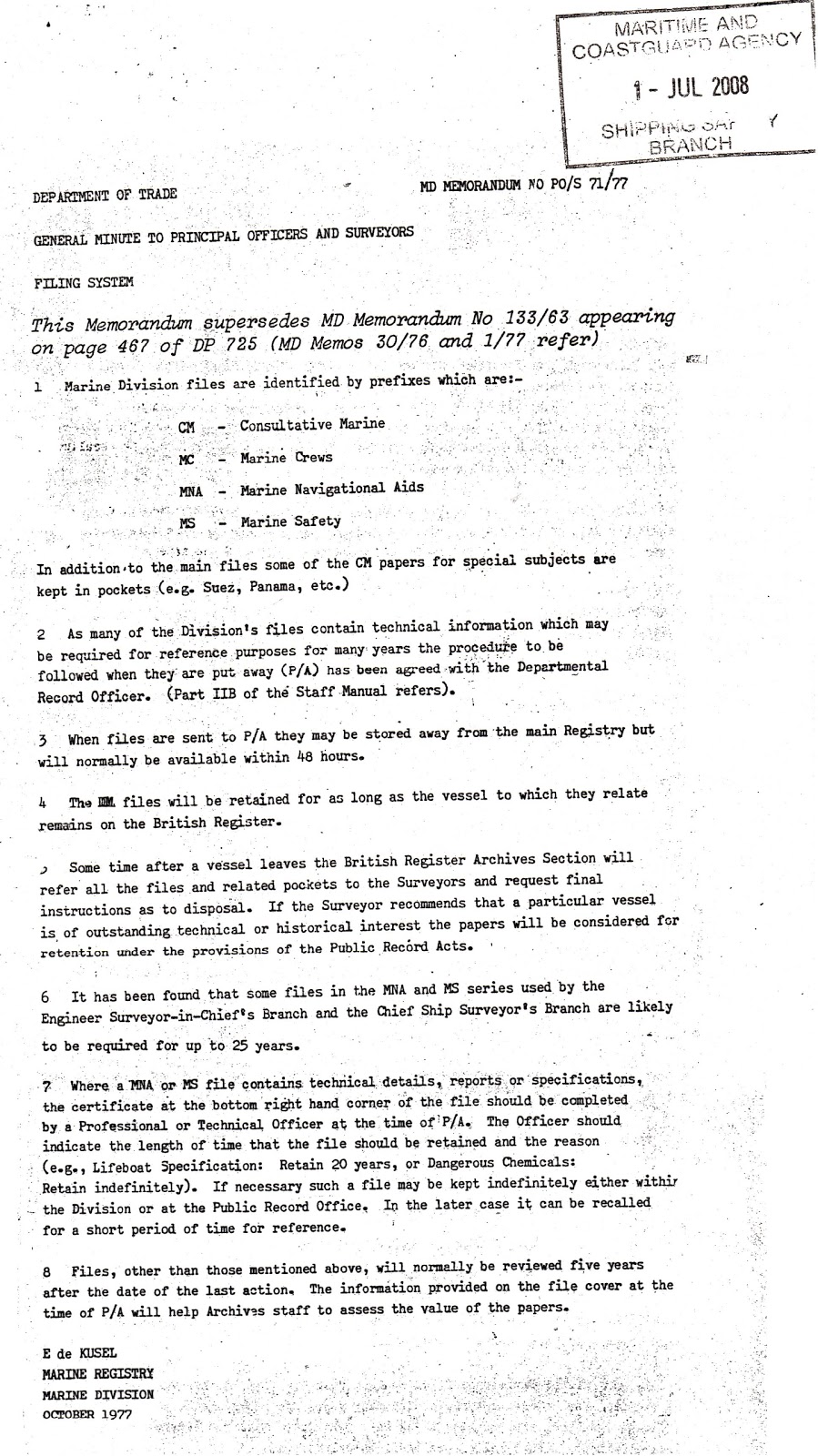
In the first instance, merchant shipping files do not go to the shredder by way of a mindless, automated routine; they are sent there when they are no longer relevant to current happenings in the shipping world (for MCA policies relating to file retention and disposal see copy of memorandum below – paragraphs 2, 5 and 7 are the most relevant. Note: files containing the results of expensive maritime safety research are not routinely shredded).


Additionally, the very fact that the wreck of the Trident was discovered in June 2001 and that the Marine Accident Investigation Branch (MAIB) were subsequently tasked with carrying out underwater surveys on it, meant that, in the first instance, the MAIB would have collected all available Trident files from the Department’s main file registry.
It was only after they had reviewed all official records and the results from their underwater surveys that the MAIB were able to advise the DfT’s Minister that ‘new and important evidence’ had been found - the basis on which Mr Stephen Byers re-opened the formal investigation in March 2002.

Once a maritime public inquiry has been opened (or re-opened), the normal procedure is for all official files and records to be taken into the custody of the DfT and AG (via the Treasury Solicitor) who will then decide which items of evidence should be released to the parties to the inquiry.

Thus, if the Trident investigation was re-opened in 2002 and the Trident stability file was shredded in 2005, it would seem that someone within the DfT specifically requested/authorised the file’s destruction. MCA officials would not have been authorised to take a decision on a file that was linked to an ongoing formal inquiry.

Perhaps the DfT could provide us with a justification for their haste.

(On this subject, there is, however, more to come…)

------------------------------------------------
[*]  By 2005, the DfT and their retained experts were well on course for a re-write of the official records on the Trident’s loss. Obviously, if there were any historical records available from that period – and if they fell into the 'wrong hands' (the FOI act came into force 6 weeks before the Trident’s records were shredded) - then these could be read!!!!

Sunday, September 12, 2010

A trip down memory lane

Having recently leafed through some old books about the Gaul, we found an interesting paragraph at page 62 in John Nicklin’s book, The Loss of the Motor Trawler GAUL, which we have reproduced below.


Sadly, Mr Nicklin is no longer with us and will not be able to read copies of two of the official memos that were circulated at that time (see below). These memos provide the answer to his question as to why the Department of Trade, who had commissioned the NMI report on the Gaul, declined to make its findings public.


The last paragraph in the memo above shows that the Department of Trade were not prepared to permit the publication of the NMI report on the Gaul’s stability, for fear that its conclusions might provide evidence to one of the parties to the litigation.


The above memo shows that only after the prospect of litigation had disappeared did the NMI think it likely that the Department of Trade would grant permission to make the results of their research public.

Unfortunately, this is all we have time for at the moment, but we shall come back to this subject (and to the Trident affair) in due course.

Wednesday, August 04, 2010

The FV Trident Investigation – Another Public Inquiry - Another national disgrace

In an earlier post we gave an overview on how the re-opened Trident casualty investigation (RFI) was being conducted and managed by the Advocate General towards an outcome that would be preferred by at least one of the departments in our current Government (the DfT).


Recently we have learnt that the JPE (the RFI’s Joint Panel of Experts) had also taken it upon themselves to rewrite the official records of Trident’s intact stability.

Work done:

The JPE have changed the official DOT lightship particulars for Trident (from those used in the original investigation):

Original investigation (OFI) 1975

Lightship displacement[1] = 149.83 tonnes (147.46 imperial tons)
VCG[2] position = 3.197m above keel (10.487 feet)
LCG[3] position = 9.971m forward of the rudder stock (3.525 feet aft of amidships)

Re-opened investigation (RFI) 2010

Lightship displacement = 153.01 tonnes
VCG position = 3.18m above keel
LCG position = 9.95m forward of the rudder stock

They have also modified the weights of the items that she was assumed to be carrying on the day of her last voyage (the original figures can be seen in the NMI/Morrall testing report page 13 and in the report of the original investigation - condition A2):
  • They increased the amount of fuel she was carrying by 1.75 tonnes to 6.75 tonnes
  • They doubled the amount of fresh water on board to 3 tonnes
  • They reduced the amount of stores in the upper focsle space from 1.5 tonnes to 0.45 tonnes and removed 1 tonne of stores from the lower focsle space
  • They reduced the weight of the fish boxes in the hold from 3.37 tonnes to 2.4 tonnes
  • They reduced the weight of the lube oil drums in the engine room by 20kg
  • They reduced the weight of fishing nets from 3.6 tonnes to 3 tonnes
  • They increased the weight of the gallows chain from 0.27 to 0.45 tonnes
  • They removed the ‘dog rope’
  • They increased the amount of engine room stores by 100kg
  • They increased the amount allowed for the crew’s effects by 90kg
In brief, the effect of the JPE’s modifications has been to increase Trident’s notional stability reserves[4] by about 10% for her final sailing and loss condition.

If we look at the stability of the Trident in both the original and the JPE-modified conditions we can see that in her original condition, Trident is clearly non-compliant with IMCO minimum stability criteria, however, after the JPE modifications have been applied, her stability improves to the point where she only marginally fails to meet the IMCO minima:


What were the motives behind the JPE’s actions?

1. To ‘update’ our official records to indicate that, contrary to the evidence contained in the report of the 1975 formal investigation and in the 1976 NMI/Morrall report, the Trident’s stability at the time of her loss 'complied substantially with IMCO'[5] minimum standards, and that, therefore, non-compliance was not a factor in her loss.

(RFI Transcript for 12 July 2010 – Advocate General page 102:)


2. To request the Sheriff to dismiss the conclusions from the original 1975 formal investigation and the subsequent model tests carried out NMI/Morrall in 1976;

(RFI Transcript for 12 July 2010, page 105:)


3. And finally to oblige the Sheriff to conclude:

(RFI Transcript for 12 July 2010, page 74)


Our conclusion

The callous way in which the current investigation into the tragic loss of the Trident and her seven crew members has been scripted by the DfT and conducted by the AG towards a pre-determined outcome reveals the depths that our Government, and those it employs, will stoop in order to maintain policies that, regardless of their warped perception of the public interest, they know are both unjust and unlawful.

This is nothing less than a national disgrace

An extended pdf version of this article is available HERE.

-------------------------------------------------------------
[1] Lightship displacement = the floating weight of the empty ship
[2] VCG = the position of the vertical centre of gravity of the ship’s weight
[3] LCG = the position of the longitudinal centre of gravity of the ship’s weight
[4] Note:  In 1975, the Court’s experts carried out a very comprehensive and careful investigation into Trident’s stability characteristics - in terms of ascertaining her empty hull weight, position of centre of gravity and the items of fishing gear, fuel, water and stores she was carrying onboard at the time of her loss. There is no substantive reason or factual basis to justify the changes that have now been carried out by the JPE.
[5] This was the stated position of the DOT throughout the 1975 Formal Investigation