Showing posts with label MAIB. Show all posts

Saturday, July 23, 2011

Stability standards for scallop dredgers - Solway Harvester and Olivia Jean

On 10 October 2009, a crewmember onboard the scallop dredger Olivia Jean was injured when a trawl wire parted and he was hit by a falling bridle. The fisherman sustained chest injuries and was subsequently airlifted to hospital

Following that accident the MAIB carried out a detailed safety audit onboard the Olivia Jean and a number of regulatory non-compliances, including stability deficiencies, were identified,

The Maritime and Coastguard Agency (MCA) were notified and they also inspected the vessel; however, they subsequently permitted the Olivia Jean to continue fishing even though the official limits in her trim and stability book were regularly being exceeded [1].

As a consequence, the MAIB issued Safety Bulletin No 1/2010, which called on the Olivia Jean’s owner to cease fishing operations immediately and on the MCA to:
Ensure that the stability of Olivia Jean (TN 35) is verified and all safety critical limitations are applied before allowing further fishing operations to take place

The release of this safety bulletin, critical of MCA, was an unusual action for the MAIB to take as generally both MAIB and MCA worked together and supported one another (both being part of the maritime section of the Department for Transport).

Perhaps the MAIB were remembering previous scallop dredger losses – the Pescado in 1991 (where six men died) and the Solway Harvester in 2000 (where seven men died) and were concerned that stability deficiencies on yet another scallop dredger could lead to another tragedy.

The MAIB would also have been mindful of the fact that in 2006 when they had published the Solway Harvester report they had been obliged, once again [2], to tidy up a mess left for them by MCA, which they did by skipping over the Solway Harvester’s stability deficiencies.

Stability Standards

Extracts from the MAIB’s casualty reports for the Olivia Jean and the Solway Harvester are reproduced below, where the stability of each vessel has been assessed by MAIB for compliance with minimum stability standards.

Olivia Jean
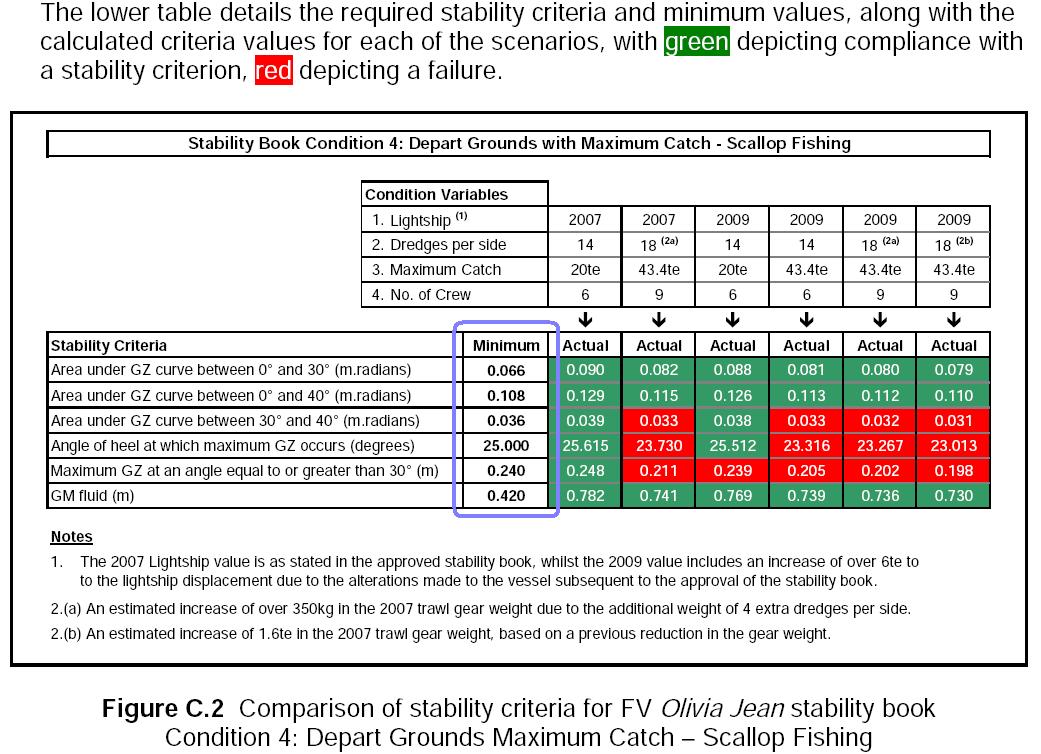

MAIB’s stability assessment - they compared Olivia Jean’s actual stability reserves against the official stability minima (ringed in purple); these minimum criteria include the 20% stability enhancement that is required for scallop dredgers. In the example shown here, the Olivia Jean fails to meet the required stability standard in the ‘depart grounds’ sailing condition.

Solway Harvester – stability curve for the loss condition

The Solway Harvester’s marginal stability reserves and poor GZ values are clearly visible from this curve:


MAIB’s stability assessment – they compared the Solway Harvester’s estimated stability reserves against the minimum stability criteria ringed in purple above; however, these minimum stability criteria, chosen by the MAIB for comparison purposes, are different from the criteria they used for the Olivia Jean – they are the wrong criteria as they do not include the 20% stability enhancement that is required for scallop dredgers and beam trawlers. However, by comparing the Solway Harvester’s stability values against a lower stability standard, the MAIB were able to say that she ‘passed’ the requirements (the figures reveal a marginal pass of the lesser stability standard).

The MAIB were aware that they were on shaky ground here and, when they published their report on the Solway Harvester’s loss, the important part within their report - where the minimum stability criteria were identified - was barely legible as well as very carefully worded.

They talk about “compliance with regulations”, yet they do not identify which specific regulations the vessel allegedly ‘passed’.
It certainly didn’t meet the regulations applicable to scallop dredgers (i.e. Rule 16 of the Fishing Vessels Safety Provisions Rules 1975 with the 20% increase in stability for fishing vessels engaged in twin boom fishing).

Moreover, it is also highly likely that, given the number of questionable assumptions made by the MAIB in their calculations for the Solway Harvester’s loss condition, she did not even comply with the lesser stability standards either.

Solway Harvester

In the above image (c/o STV website), the Solway Harvester can be seen sailing in a deeply laden condition where her freeboard and stability reserves are clearly suspect. In the above image, the blue arrow indicates the position of her watertight main deck – only just above the sea-surface.

It should be noted that Solway Harvester’s design allowed seawater to freely enter the non-weathertight steel enclosures and wash across her decks.

If, as shown in the sketch below, the non-weathertight enclosures are removed, the watertight hull and three-weathertight superstructures become apparent. The main deck is only just above the sea-surface (arrowed) and thus, when the above photo was taken, the only things keeping the vessel afloat and upright at that time were the meagre buoyancy reserves provided by the small part of her hull above seawater and the three small superstructures.

MAIB report no. 1/2006

Concluding remarks

If, on 11 January 2000, the Solway Harvester had complied fully with official stability standards it is just possible that, she would not have succumbed to the weather and capsized with the loss of all onboard.

---------------------------------------------------------------
[1] The MCA have sole responsibility for statutory surveys, stability approval and the issue of fishing vessel safety certification on UK fishing vessels.
[2] The MAIB have had to investigate and report on a number of fishing vessel casualties where the MCA’s ‘light regulatory touch’ has been an obvious factor in the loss.

Wednesday, April 06, 2011

FV Trident RFI – short memory

"We've met, but you don't remember me. I worked for a company you hired to have part of your memory erased." (Quote from the movie "The eternal sunshine of the spotless mind")

No, we have not abandoned the subject of the Trident RFI, and, as far as we are concerned, this matter is far from over. But we must take one thing at a time.

We have already commented on the response received from the Marine Accident Investigation Branch of the DfT following our request for their report that recommended the Secretary of State for Transport to re-open of the Trident inquiry.

In that response dated 15 December 2010, the MAIB provided us with a ‘draft’ summary report on the loss of the Trident and stated that they had no evidence in their files "that the MAIB made a recommendation to the Secretary of State that the Formal Investigation should be re-opened."

From their end, the Department for Transport have now advised us that they had also been unable to locate the document containing the recommendations made by the Chief Inspector of MAIB to the Secretary of State for Transport, prior to the latter’s order to resurrect the investigation. (According to the Merchant Shipping Act a re-opening of a formal investigation is only mandatory if ‘new and important’ evidence comes to light.)

Thus, we were amazed to learn that, at a time when the Trident RFI had not yet been closed, the government had no record of why they had opened it in the first place.
From what we have seen, it looks as though the inquiry was re-opened in order to produce the very evidence necessary as grounds for re-opening the inquiry.

So, why was £6mil spent on re-hearing the Trident formal investigation in its entirety? In our view, the inspection of the wreck did not invalidate, but added extra certainty to the original conclusions of the 1975 OFI. These conclusions were further validated by the NMI model tests, which, relative to the OFI, also constituted new and important evidence. Would it therefore not have been better to make all the historic evidence public, re-open the inquiry for one day, at a small fraction of the costs incurred, and re-state the findings of the OFI, this time, with a greater degree of confidence?

Would it also not have been better if the money spent on legal fees and manufacturing evidence had been used to compensate the victims’ families?

Monday, February 28, 2011

FV Trident RFI - A question


We have a question that nobody seems willing to answer and which is: why nobody from the Department for Transport, the Maritime and Coastguard Agency, MAIB and the former DOT was ever called to give evidence under oath during the Trident RFI hearings?

Wednesday, February 23, 2011

The Trident and Aquila inquiries ... and interesting facts about scallopers


We think that we may have found one of the reasons for the delay in finalising the Trident’s RFI report: the DfT is keeping Mr Macwhirter, the Assessor in the Trident inquiry, very busy these days, as he is also giving evidence, in his role as stability expert for the MAIB, in the Fatal Accident inquiry into the Aquila tragedy. (See press article HERE)

Mercifully, the experts in that inquiry have not seen the need to delve too deeply into vessel motions and dynamic stability topics, and appear to be ready to arrive at their conclusions concerning the loss of the Aquila by reference to contemporary stability standards only.

That being said, we must admit to being somewhat surprised to learn from the Press and Journal article that Mr Macwhirter considered the “extra weight alterations to the Aquila over the years were unlikely to have caused the capsize”, as he had also previously stated that the extra weight on the Aquila had led to a significant deterioration in her intact stability [1] reserves.

So, we thought we would check his further views in the MAIB’s ‘Aquila’ report:

9. Conclusions:
Further analysis indicated that even if the Aquila had fully complied with the stability requirements, it was very probable that capsize would still have occurred [2]

At first glance, this statement appeared quite familiar to us once we realised that, if we substituted ‘Trident’ for ‘Aquila’ in the above sentence, then this would be exactly the same conclusion that the experts in the Trident RFI are striving to arrive at!

There is a striking level of consistency here!!!

And, if we think about this some more, it looks like we are being invited to believe that official ‘stability standards’ have little value when it comes to preventing capsizes of Scottish fishing vessels.

We would take a contrary view and suggest that, apart from being nonsense, this is not really the type of message that a responsible Maritime Authority (like the DfT) should be promoting.

---------------------------------------------------------------

[1] And thus be more likely to capsize

[2] Unfortunately the “stability requirements” that Mr Macwhirter used as the basis for his analysis were for side and stern trawlers only, not for scallop dredgers (as the Aquila was). Scallopers are required to meet an enhanced stability standard (i.e. trawler stability standards increased by 20%). Now if the Aquila had indeed met the scalloper stability standard ….what would his conclusions have been regarding her probability to capsize?

Monday, January 10, 2011

Honour and Justice

For reasons which we shall delve into later, in a separate post, the government has not yet provided the answers we had expected and knew to be correct.

Meanwhile, a new Freedom of Information request has been lodged with the Department for Transport, which reads:

Grounds for the re-opening of the Formal Investigation (RFI) into the loss of FV Trident by the Secretary of State for Transport under the provisions of the Merchant Shipping Act

Recently obtained MAIB documents concerning pre-RFI matters related to FV Trident state that "The chief inspector of marine accidents will recommend to the secretary of state if there are grounds for the formal investigation to be re-opened or not."

Although the discovery of the wreck of the Trident, itself, in 2001, meant that new evidence was found, for the condition of "new and important" evidence to be satisfied and hence for the Secretary of State for Transport to be able to order a re-opening of the Trident investigation in accordance with the provisions of the Merchant Shipping Act, a survey of the wreck and an analysis of its findings by MAIB technical experts was necessary.
It was only on that basis that the "new" evidence could have been deemed as being also "important" - the pre-requisite for a new inquiry.

The official FV Trident Formal Investigation website (maintained by the DfT) states clearly that "In August 2001, the Marine Accident Investigation Branch carried out a more detailed examination of the wreck to confirm its identity and to see whether there was anything that would either contradict the original findings or, indeed, confirm them. The discovery of the wreck together with the examination was new and important evidence."
This official statement means that the examination of the wreck by the MAIB found evidence, which either confirmed or contradicted the findings of the 1975 inquiry.

I would therefore be grateful if you could provide me with the information you hold on the MAIB findings, which triggered the re-opening of the Trident formal investigation. Did they confirm or did they contradict the original findings?

I would also request a copy of the recommendation made by the chief inspector of marine accidents to the Secretary of State for Transport, Mr Stephen Byers, prior to his order for the re-opening of the investigation on 28th March 2002.

Looking forward to a new batch of disinformation and spin which, in due course, will surely emerge from the Department for Transport.

Thursday, December 23, 2010

FV Trident Investigation - the paper trail (part 3)

Some comments on the MAIB’s 'summary report'

Although in our previous post we advised that we wouldn’t like to embarrass the MAIB by commenting on the technical content of the summary document they recently released, having subsequently learned that, in September 2009, the MAIB had also tried to pass off this very same document to the relatives of the Trident’s crew as being a copy of Admiral Lang’s official report to the Secretary of State for Transport, we have decided that, in these circumstances, we ought to change our minds.

When we first received this document, a document we did not request, we questioned the MAIB’s Chief Inspector of Marine Accidents on its status and suitability for publication, we also suggested that the ‘report’ was incomplete, not impartial and that an inspector, who was probably not competent to make pronouncements on Trident’s stability, had drafted it.

We received the following reply:

…..My position is that you made a valid request for information that we hold. The report you refer to is in our files and, in my view, I was obliged to consider whether it could be released. I have made my decision in good faith…….. However, I do find offensive your suggestion that any MAIB employee was not impartial or was incompetent. In the 6 years I have worked for the Branch I have been more than impressed by the commitment, enthusiasm and pure talent of my staff……
………I do not intend to debate this issue with you any further.
(Steve Clinch, MAIB Chief Inspector)

A copy of this MAIB document is available in pdf format HERE; we have also reproduced a few representative paragraphs below, together with our comments – which question the MAIB’s impartiality and competence in matters pertaining to Trident’s stability:

Page 3

  • The most important point here (omitted by the Inspector) was that in 1975 the Court of Investigation had already concluded that the stability of the vessel was probably deficient; this was not mere speculation by the next of kin and the media.

Page 12

  • The Inspector has stated here that Trident’s sister vessel had only minor stability deficiencies and that when she sailed in a similar condition to the Trident (as lost), she had adequate stability – thus implying that Trident also had adequate stability. However, the Inspector has omitted to mention the fact that, in the conditions he quotes, the Silver Lining had already been provided with an additional 8 tons of pig iron ballast to counter her stability deficiencies - Trident did not have this ballast onboard at the time she was lost.
    Additionally, after having read the report of the 1975 Formal Investigation, his summary report should have taken account of the Court’s views on the Silver Lining’s stability (page 6):
    Without going in detail into the owner’s complaints regarding Silver Lining, it must be noted that despite the addition of 8 tons of ballast, her stability is still in considerable doubt.
  • On page 15 the Inspector also implies that, following Trident’s loss, the reason why Silver Lining was laid up and lengthened by 10 feet was because of factors other than deficient stability (i.e., difficulty in getting a crew and for insurance purposes, which are consequences of the vessel’s deficient stability rather than direct causes of her lay-up and lengthening).

Page 16

  • Here the Inspector seems ready to accept that Trident’s stability was adequate based upon the testimony of her owner. We have carried out a simple stability check and ascertained that the Trident would have capsized in any of her sailing conditions, if the powerblock had borne a direct load of 26 tons, as described above. In any case, the gear on Trident was incapable of a direct lift of such magnitude and would have probably failed before capsizing.

  • The Inspector again has made a statement that cannot be supported by analysis. We have carried out a brief calculation and found that, if the net (weighing about 1.3 tons) shifted to port or starboard by 2.5m, the vessel would have heeled by about 2 degrees (i.e. not a large angle of heel)
Conclusions

The underlying tone of this document, recently released by MAIB, seems to be that the families of the deceased and the media have somehow exaggerated the possibility that Trident had been deficient in stability.
The fact that this MAIB document plays down the principal conclusion of the original investigation (OFI) regarding the Trident’s stability, and the fact that the outcomes from the NMI Trident model tests, which added weight to that conclusion, have not even been mentioned, raise further questions as to its objectivity and impartiality.

In a previous communication to us, the Chief Inspector of Accidents admitted, that the MAIB reports only had the legal status of OPINION. In that case, we would argue that the public does not really wish to pay out a lot of money for casualty investigations that only deliver DfT opinions; what they would prefer, to be sure, is to receive information as to what actually happened and the reasons why an accident occurred – delivered promptly from an impartial and competent source.


(More to come)

Sunday, December 19, 2010

FV Trident Investigation - the paper trail (part 2)

Our latest dealings with the Marine Accident Investigation Branch (MAIB) have not been very fruitful. (Not that they have been fruitful in the past, when we approached them in connection with the Gaul RFI.)

Conceding to our request for information on the role that MAIB played in the run up to the Trident RFI, the head of the MAIB has sent us four documents - one of which wishes itself to be a summary of the MAIB’s views on the loss of the Trident following their underwater survey of the wreck and prior to the re-opening of the official investigation in 2002.

The document in question records some generalities relating to the Trident accident, a few anecdotes of disputable value, a fairly absurd technical assertion (we won’t reproduce it here so as not to embarrass the MAIB staff), an inaccurately justified denial of Trident’s stability problems, and an ambivalent statement as to whether the FV Trident formal inquiry warranted a re-opening in accordance with the provisions of the Merchant Shipping Act.

This was in no way the robust recommendation to the Secretary of State for Transport that, as announced at the time in the press, you might have believed the re-opening of the Trident inquiry had been based on. No, we are led to think that the MAIB left it to the politicians to decide this for themselves, unencumbered by a definite technical viewpoint[*]
The MAIB’s experts’ only judgement was that new evidence about the vessel had been found (quite obvious, since the wreck had recently been located and surveyed), but they couldn’t say whether or not that new evidence was important enough to give grounds for another formal inquiry. What the MAIB also omitted to add was that the discovery of the wreck in itself tended to reinforce the conclusion of the original inquiry that: “inadequate stability is the factor most likely to underlie her foundering in conditions which would not normally have overwhelmed a ship of her size”

(Well, we know now that the evidence most relevant to the cause of the loss - the National Maritime Institute’s model tests and research - was not new, except to the families and the public. The results from the NMI research, coupled with the discovery of the wreck should have been reason enough to allow the inquiry to be re-opened and to conclude that: “inadequate stability led to her foundering in conditions which would not normally have overwhelmed a ship of her size.”)

Now, going back to the released MAIB documents, we have also noted that their brief summary on the Trident did not refer to the NMI research data on the Trident’s stability – that very interesting file that the DfT claims to have shredded. Although the MAIB had to admit that they had had unrestricted access to all the official documents related to the vessel, they only mentioned the A. Morrall technical paper - ‘Capsizing of small trawlers’, which is a sort of sanitised derivative of the original NMI research on the Trident.

Well, well, who can seriously believe that such a top organisation as the MAIB would not have used the real data contained in the DfT’s official files?!

Anyway, what caught our eyes above all that was the fact that the MAIB’s summary, apart from being fanciful and superficial, looked as though it had been made ad-hoc, to entertain us. The document had no date, no author, and the MAIB’s Chief Inspector did not even know whether and to whom it had been addressed. He just found it somewhere “in the system”. (Well, if this document was compiled or modified after our request for information and specially for that purpose, then, I think, this sort of undertaking has a rather unpleasant name to it…)

And that is all we’ve learned from UK’s prestigious Marine Accident Investigation Branch. To find out more, the Chief Inspector advised us, would cost more than £600. Furthermore, we were also told, the “the key players involved in the MAIB’s work have since left the organisation.” That is exactly what the Head of Shipping Policy in the Department for Transport told us once, in response to our questions about of the Gaul RFI.
Just like the tribal chief who said to his visitors: we no longer have any cannibals in our tribe - we ate the last one yesterday…

(More to come…)

--------------------------------------------------------------
[*] Apparently, an unequivocal recommendation for the re-opening of the investigation came from a non-technical quarter, namely, from the Office of the Advocate General in Scotland.

Wednesday, December 08, 2010

FV Trident Inquiry - The MAIB leaves no traces

As we announced in our post of 15 November 2010, we lodged a FOI request with the Marine Accident Investigation Branch (MAIB) of the Department for Transport asking them a few simple questions aimed at clarifying their role in the FV Trident Investigation.

The response from MAIB, which we received yesterday does not clarify anything. What is more, it gives the false impression that the MAIB did not play any technical role (or keep any records of its role) in the run up to the Trident RFI, and goes on to suggest that, even if it had played such a role, this ought to remain an official secret.
To bolster their equivocation, the MAIB misinterprets the Merchant Shipping (Accident Reporting and Investigations) Regulations 2005 and tries to apply the prohibition clause therein, not only to the content of restricted documents or evidence[*], witness statements, or the personal details of any persons making such statements, but also to the question of whether they hold such evidence in their coffers.
Notable, however, is their reluctance even to address our query about any advice the MAIB might have provided to the DfT and the Office of the Advocate General for Scotland, in the run up to the Trident RFI.

As this blog bears witness, we have had encounters with the MAIB before, in connection with the Gaul investigation, and they were just as unhelpful. So it does not surprise us in the slightest to read their attempt at obfuscation in the Trident case now.

Well, as they say, 'once your reputation’s gone, you can live a life of fun'. And this is the obvious trend in most of our governmental institutions today.

---------------------------------------------------------------
[*] The Sheriff presiding over the FV Trident RFI has, nevertheless, the powers to call for such prohibited documents and evidence.
 

Monday, November 15, 2010

FV Trident Investigation - the role of the MAIB

So far, the Marine Accident Investigation Branch (MAIB) has been sheltered from the strong winds blowing around the ongoing Re-opened Formal Investigation into the loss of  FV Trident.

However, we know that, prior to the re-opening of this new investigation, the MAIB played an important role in assessing the causes behind Trident's loss.  We have now sent them a Freedom of Information request that, hopefully, will shed some light upon the official handling of this case.

NOTE: In the Gaul RFI, the MAIB produced a detailed report (Rep no.4/99) which accompanied their recommendation for a re-opening of the Gaul investigation. It is therefore to be expected that at least the same level of service and transparency should have applied in the Trident inquiry.

Monday, December 31, 2007

An old theory re-surfaces

At the beginning of December, a new book saw the light of the day. Fishing Explorer – authored by Ernest Suddaby, a former skipper of the Gaul, and published by Maritime Info UK Ltd - makes a very pleasurable read.
Put together with brilliant literary skill, printed in excellent graphic conditions and warmly prefaced by Alan Johnson MP, the book offers the reader a rich source of documentary information and photographic material.
The book carries two main narrative threads: one which depicts the author’s trip to the Falklands and one recounting his time as skipper onboard the Gaul, interspersed with personal memories and anecdotes.
In his account of the Gaul, along with his impressions and recollections of past events and more recent developments in the Gaul saga – many of which are well worthy of note - the author also shares with us his disagreement with the results of the 2004 Formal Investigation, and his personal opinions as to the causes that might have led to the loss of the vessel.In the author’s view, the sinking of the Gaul was caused by foul weather and bad luck, which led to flooding through the two fish loading hatches cut into the trawl deck. These hatches, it is suggested, could have been opened by the pull of gravity, when the vessel rolled beyond 90 degrees in heavy seas.
Mr Suddaby’s hypothesis is not that new, in fact it has been, if we may say so, previously enjoyed. It is what the results of the first formal inquiry, held in 1974, implied. The MAIB also flirted with this theory for a while, although, after the 2002 underwater survey and further reflection, they decided to abandon it. They did not, however, explain very well why.
Therefore, we have taken it upon ourselves to try and present the reasons why this loss scenario is merely a conception (so as not to say mis-conception) rather than a real possibility.
To elucidate matters, we have compiled the video clip below, which, in a simplified manner, attempts to show how the fish loading hatches on the Gaul would have behaved under various roll conditions. The model presented therein shows that gravity – which inexorably acts downwards at all times and circumstances - would have had the effect of keeping the hatch covers closed and prevented seawater from getting inside the ship, when the ship rolled to an angle of 90 degrees from its vertical position. The model also shows that, when the ship rolled beyond 90 degrees, the hatch covers would have still been kept closed by seawater pressure, and that this would have happened even without taking into account the effects of the hydraulic ram system, which was connected to the hatches.
Enjoy!

Monday, November 05, 2007

Sinking Sequence

Following our post of 31 October 2007 in which we mentioned the DfT’s persistent ‘belief’ in the expert analysis that had been carried out during the Gaul Formal Investigation.
Once again we feel obliged to persist ourselves, by pointing to a number of additional anomalies in this ‘expert analysis’.
These anomalies relate to the 2004 RFI panel’s conclusion that the Gaul sank ‘stern first’ and hit the seabed ‘stern first’ before coming to rest in the position in which it was discovered by Norman Fenton’s survey team in 1997.
The available evidence reveals, however, that the information obtained from the MAIB underwater surveys does not actually support the conclusion of the RFI but, quite the opposite, suggests that, in fact, the vessel sank ‘bow first’ and also came into contact with the seabed ‘bow first’.
(For a more details on this point of contention, please see this linked DOCUMENT.)

Photo mosaic of Gaul wreck's outer hull superimposed on body plan
(Crown copyright)

This more likely suggestion that the Gaul sank ’bow first’ is also consistent with the scenario (put forward within our post of 16 September 2007) in which the fish loading hatches had been opened by the pressure of the air trapped inside the vessel as she was sinking rather than due to crew error, as the RFI panel chose to believe.
Once again it can be seen that the RFI panel examined the available evidence in a loose manner, trimming the edges of the jigsaw pieces so they fitted together into a distorted picture that was meant to deceive.

Wednesday, October 31, 2007

The closed system

“The Department is satisfied that there is no reason to doubt the outcome of the expert analysis that led to the Re-opened Formal Investigations conclusions and consequently there is no reason to re-open the investigation,” says the message sent to us by the Department for Transport on 8 October 2007.
So, the DfT are still proclaiming their faith in the merits of the 2004 Gaul RFI which, it is no longer a secret, did not lead to anything, except injustice and frustration, driving the whole purpose of a formal investigation onto precarious ground.
“You have informed me that the technical report, related documents and information published on the following sites: http://the-trawler-gaul.blogspot.com and www.freewebs.com/inconvenientcitizen, had been viewed by technical experts within the DfT before your latest decision not to re-open the investigation was taken.
I would therefore be grateful if you could tell me who these in-house experts are.”
We gently inquired the very same day.
Well, the DfT have, so far, been unable to give us the reply. They need, it seems, legal advice on how to answer the question.
Why take such precautions? We had only asked for the names of the experts involved… Is it because no in-house technical specialists have been in fact consulted? The DfT draw their technical expertise from agencies such as MCA and MAIB. These, as far as we know, have not yet been requested to advise the Department on any of the technical matters that had been raised... Is it because their advice might not be what the DfT would like to hear?
Anxious and unable to either refute our disclosures or renege the schemes of the previous administration, the DfT is therefore stuck, mindlessly repeating the same old line.

While it may first appear as bizarre, their attitude is quite explicable: the system created by our political regime cannot simply over-ride itself in order to correct the wrongs of that regime.
Inhabitants of a closed system, like the one described by the Michelson and Morley experiment, our government departments and their institutional dependants are, moreover, unable to observe the absolute actions of that system from the outside - trapped as they are within their own relativity, and so much preoccupied with self-preservation.

Wednesday, October 24, 2007

Making bubbles

In our post of 16 September 2007 we showed that the calculations for the pressure of the air, trapped inside the Gaul as she sank, which are contained in the MAIB report no 4/99 and were relied upon during the 2004 RFI, are incorrect.
These calculations were performed by BMT, the company which MAIB had sub-contracted to carry out this simple task on the their behalf.
Unable, perhaps, to consign the work to one of their own specialists, or even consult their encyclopaedias, or other publications such as Popular Mechanics, the MAIB decided to farm it out. Generously paid for by the taxpayer, BMT appear, nonetheless, to have got it wrong…
Anyway, when recently asked to offer his comments on the errors identified in their report, the Chief Inspector of Marine Accidents at MAIB, Mr Stephen Meyer, sent us a rather incongruous and terse reply: our emailed inquiry, he said curtly, did not provide grounds for re-opening the Gaul Investigation (?!) (His strange response reminding us of that absurdist joke with the two elephants in a bathtub; where one said “soap” and the other one said “radio”)
Well, of course our email didn’t provide such grounds: it hadn’t been intended to; it only pointed out that there was a small bit of trouble with their sums.
The rest of our technical evidence and disclosures, however, do provide the grounds - but Mr Meyer, alas, couldn’t comment on that.

Saturday, April 28, 2007

The hot-potato game

In our post of 17 March, we reported on our attempts to obtain two documents held by the Department for Transport (DfT), which are mentioned in the Gaul RFI EXPERTS' PROTOCOL (paragraphs 3, 8 and 9) and which, frankly, should have been published within the final report (as was the case in the MV Derbyshire RFI).
Having failed to lodge a request for these papers via the parliamentary route, on 19 March, I sent THIS EMAIL to the DfT.
Since then, we have managed to obtain a copy of the first document (i.e. the list of “all” possible scenarios for the loss of the Gaul) from the MAIB. (This list looks quite interesting and we intend to comment on it separately, in due course.)
The second document that we would like to obtain, (i.e. the joint report, which gives details of the RFI experts’ consideration of the various loss scenarios that had been put forward during the investigation), the DfT is still not able to provide.
Chased up on this matter, the head of Shipping Policy 4, not too thrilled to hear from us again, said that the Department was now depleted of staff with intimate knowledge of the Gaul affair, so he had had to refer our request to the Treasury Solicitor. The latter, we were told, is now the only person left at the scene, able to guide the DfT in their search for the document in question.
I hope that the joint report – central piece of the £10m investigation - has not been misplaced or mislaid…
As I write these lines I am touching wood.

Thursday, March 22, 2007

Inconsistencies

On the rare occasions when we managed to get a reaction from them, the UK Marine Accident Investigation Branch claimed, hand on heart, that their investigators role in the Gaul RFI had been limited to the mere provision of the underwater survey video footage and technical drawings. The MAIB did nothing more than “act as agents” “leaving the retained experts in the formal investigation to draw their own conclusions” as to the causes of the accident. This version of events was also backed by Dr Stephen Ladyman, the Transport Minister, in his response to a parliamentary question.
However, Para 3 of the Experts’ Protocol in the Gaul Re-Opened Formal Investigation, which was drawn up in October 2002 and annexed to the 2004 RFI final report, states a rather different thing: “A list of all possible scenarios has previously been drawn up by MAIB in consultation with the families’ experts which should form the basis for further work.” This somehow appears to contradict the MAIB’s non-interference claims.
Anxious to solve this inconsistency, we have requested both the MAIB and the Department for Transport that a copy of this list be made available to us. In reply to our request, the MAIB sent us this email. From DfT we haven’t heard anything yet – nothing, except the sound of steps scurrying away from the torchlight.

Wednesday, March 07, 2007

'Secret Agents'

In 2002 the MAIB carried out an underwater survey of the wreck of the Gaul and produced over 3,000 hours of high quality video footage.
The survey vessel used, MPSV Seisranger, was equipped with nine Remotely Operated Vehicles (ROVs), including several mini-ROVs. The cost for this operation, as the Transport minister advised, amounted to about £3 million.

During the 2004 Re-opened Formal Investigation parts of this video footage were examined by the retained experts and a few selections from this material were afterwards attached to the RFI final report as evidentiary material and placed in the public domain – the coverage of the duff and offal chutes themselves, the very cause of the sinking, representing only a minuscule part of these selections (approx. 64 seconds).

Wishing to obtain some of the missing sections in digital format, so we can publish them more easily, we asked the MAIB to release parts of the footage that were not in the public domain.
In reply to our request, the Chief Inspector of Marine Accidents sent us the following statement:

“MAIB was only acting as an agent in the 2002 Gaul survey, so does not hold any copy of the videos taken.

I am sorry that we cannot assist further”

So, then, the MAIB were acting as agents in the Gaul formal Investigation.

What kind of agents would that be?

Tuesday, November 21, 2006

Comments from MAIB

We have received a response from the Marine Accident Investigation Branch. Please see HERE.

Wednesday, November 01, 2006

The Sergeant Schultz Syndrome

I have been in touch with a senior Maritime Accident Investigation Branch (MAIB) source, who had been involved in the preparation of the Gaul case prior to the 2004 formal investigation.
Asked whether the MAIB had provided information to the wreck commissioner (i.e justice david steel) in respect of the patent design defect in the construction and arrangement of the duff and offal chutes on the Gaul, he would say neither Yes nor No.
As to the pre-investigation deliberations that had taken place between MAIB and other experts on the subject of the faults in the construction of the chutes he had no clear recollection.
Whilst in other cases the MAIB would collect evidence and provide analysis on the causes and circumstances of a marine accident, in the Gaul case, I am told, the MAIB provided the documentary evidence, but left the government’s retained experts to formulate their own conclusions. The MAIB, my interlocutor said, was in a difficult situation vis-á- vis the Gaul case.
I wonder why.

Saturday, October 28, 2006

Questions on answers or How to communicate economically

Sandra Gidley: To ask the Secretary of State for Transport what estimate he has made of the total cost of investigations and inquiries into the loss of the F. V. Gaul in 2006 prices. [96789]
Dr. Ladyman: The total cost to the Department of investigations and inquiries into the loss of the FV Gaul was £6.5 million.

No adjustment has been made for 2006 prices.

Gadfly: Perhaps Dr Ladyman should know that the Original Formal Investigation was concluded in 1974.

There appear to be some items missing from the above list. The total costs to the Department should also have included:

1. the costs of the stability and seakeeping investigations and model tests carried out for the Department by NMI and YARD between 1975 and 1978 estimated at £75,000 (in 1976 prices)

2. the costs of the two reports by Roger Clarke published in 2000. Stated to have cost the Department £50,000 at that time

3. additionally, the costs of 32 years of governmental time that has not been included in the above (political staff, technical, clerical and administrative staff, MOD, legal etc) - £1m at todays prices would not be an unreasonable evaluation!

If a simple compound interest calculation is carried out on the costs detailed above, using historical Bank Rate indices, then a figure of £10m at 2006 prices is obtained!

See also: http://www.dailymail.co.uk/pages/live/articles/columnists/columnists.html?in_article_id=371759&in_page_id=1772&in_author_id=244

Sandra Gidley: To ask the Secretary of State for Transport what progress has been made towards the implementation of the formal safety recommendations arising from the F. V. Gaul Re-opened Formal Investigation. [96790]

Dr. Ladyman: It is considered that, as far as is reasonably practicable, the recommendations have been implemented.

Gadfly: The four formal safety recommendations have not been implemented.

Sandra Gidley: To ask the Secretary of State for Transport whether any evidence of a design fault in the construction and arrangement of the duff and offal chutes on the trawler F. V. Gaul was made available to the Wreck Commissioner during the 2004 investigation. [96794]

Dr. Ladyman: The Marine Accident Investigation Branch provided the inquiry with a copy of a full set of technical drawings for the vessel, a number of which detailed the design of these chutes. These drawings were reviewed by the technical experts and the expert representing the Department for Transport referred to these drawings in the production of the document “Notes on the duff and offal chutes”, submitted to the Re-opened Formal Investigation. These notes included comments on the design of the chutes and the potential design inadequacies.

Gadfly: First of all, the question that had been asked was not answered (i.e. was any evidence of a design fault made available to the Wreck Commissioner?). A yes or no answer would have sufficed.
Secondly, The Marine Accident Investigation Branch would provide, as they normally do and as the Treasury Solicitor recently confessed, “considerable assistance” to the Wreck Commissioner. They would therefore provide much more than a set of old drawings.
Thirdly, the “Notes on the duff and offal chutes”, only commented on a presumed design deficiency in relation to the difficulty of maintenance of the non-return flaps.So, in a couple of sentences, Dr Ladyman implies that either the MAIB performance was poor, or the MAIB witheld evidence, or the retained experts were unable to recognize an obvious design fault in the construction and arrangement of the duff and offal chutes.

***

“When you hear a denial of knowledge or responsibility, rate it carefully on the plausibility scale. The real culprit is usually at the top, as his nose will eventually demonstrate”. (Patrick Brown, 1999, Plausibility and Pinocchio)