Monday, February 28, 2011

FV Trident RFI - A question


We have a question that nobody seems willing to answer and which is: why nobody from the Department for Transport, the Maritime and Coastguard Agency, MAIB and the former DOT was ever called to give evidence under oath during the Trident RFI hearings?

FV Trident RFI - a costly farce


The Trident RFI followed the same script as the Gaul RFI - to the letter.

Sunday, February 27, 2011

FV Trident RFI - “No evidence was led at the inquiry…”


Perhaps the most important question for the RFI, once it had established that the Trident had capsized in sea conditions that were not exceptional and that her intact stability was deficient, was whether full compliance with the IMCO minimum stability standard would have prevented Trident’s capsize and the loss of seven lives.

Unfortunately, this was one critical question that the RFI's investigators were unwilling to answer. They were prepared to answer questions that skirted this central issue, they also touched upon matters on the fringes of this issue and were happy to pontificate at great length about many things that seemed to be related, but in fact deflected attention elsewhere.

Perhaps the nearest we can get to a straight answer on this important point is contained within the Sheriff's comments in Para [41] of his final report:

The first question here is what changes would have had to have been made to the design and construction of the Trident to secure full compliance with the IMCO recommended criteria when she was built. No evidence was led at the inquiry, which would allow me to answer this question, so it is impossible to hold that, if she had been built so as to secure full compliance with these criteria, she would not have been lost.

But surely, Your Honour, as you were in charge of this £7m inquiry, you should have given directions that evidence be obtained and led on this matter?

You were eager to dismiss the results of the 1976 NMI model tests, the report from which, co-incidentally, showed that Trident would have survived if the IMCO Stability criteria had been met. In the words of Dr A. Morrall:

Experiments in breaking waves were repeated and no capsize was obtained. Test periods of up to 1 hour full scale were carried out. Motions were extremely severe and decks were very wet and an impression was gained that limiting conditions for survival had been reached.

Instead we have been asked to accept the conclusions that were drawn by a panel of experts, whose objectivity can be disputed, from a very limited and questionable set of test results from the MARIN test facility in Holland.

Question

Why was the Trident model NOT tested at the MARIN test facility in a condition representing full IMCO compliance so as to see whether or not she would capsize?

If tests had been carried out in this condition, then we would have had a straightforward and conclusive answer to the main question above.

This would not have been a difficult or expensive test to arrange, and it would have provided concrete evidence for the RFI. In fact, when a similar test was carried out at the NMI test facility in 1976 Dr Morrall commented: "this was achieved quite easily by rearranging the ballast inside the model and carrying out an inclining experiment to check"

Perhaps we already know the reasons why evidence was not sought or allowed on this point. The OAG, DfT, Seafish and a number of other parties just did not want to hear the answer that:

If Trident had met the IMCO minimum stability standard, she would have survived.

More to come…….

Saturday, February 26, 2011

FV Trident RFI - The development risks defence [*]


In earlier posts, concerning the Derbyshire and the Gaul disasters [http://mv-derbyshire.blogspot.com/2008/10/dry-run-for-litigation.html], we have highlighted the fact that formal investigations into maritime casualties are mainly driven, not by a desire to seek out the truth of the matter, but by the over-arching principle that any form of litigation ,which could be harmful to Government or the British Establishment, must be avoided at all costs.

We have now seen that, throughout the Trident RFI, this principle has remained the primary driver of events.

An example of this can be seen in Question 5, posed by the AG: 
5. At the commencement of her last voyage was the Trident unseaworthy (as determined by the standards which applied in 1974)…

This question enabled the Sheriff to give a ruling, which would support the ‘development risks defence’ argument, in any future product liability case, where compensation was sought.

His response, in paragraph [49], states:

What happened to the Trident on the day of her loss was not reasonably foreseeable to anyone in light of the knowledge and understanding of the design and construction of seagoing vessels available at the time.

While the clear intention of the Sheriff’s statement is to support any future ‘development risks defence’ argument, the statement in itself is clearly nonsense. In 1974, fishing vessel capsizes were an all too frequent occurrence and what happened to the Trident was, in fact, foreseeable; that is why, at that time in the UK, there was a requirement for fishing vessels to be designed and constructed to meet the IMCO minimum stability standard.

It is our belief that public inquiries should be about seeking the truth, not about providing cover for potential defendants.

---------------------------------------------------------------

[*] http://www.jstor.org/pss/4507206

FV Trident - Design faults


The FV Trident had significant deficiencies in her stability reserves that remained unresolved from the time she was delivered in 1973 until she capsized in 1974. This factor has been glossed over in the Sheriff’s final RFI report published this week.

The Trident should have been designed and built to meet the requirements of the building specification and contract. This contract, amongst other things, stipulated that the Trident should satisfy the IMCO recommended minimum standard for intact stability (this criterion within the build contract had been included as a pre-condition to significant Governmental grant aid towards Trident’s building costs – an important issue at that time and part of an initiative to try and improve the fishing industry’s appalling safety record)

Unfortunately, upon completion of building, the Trident sailed from the builder's yard without undergoing an inclining experiment and the actual status of her stability reserves, vis-à-vis compliance with the IMCO minimum stability standard, remained a factor that was ignored until a detailed investigation into her actual stability reserves was carried out following her loss.

Subsequent stability calculations during 1975-8 and within the past decade have all indicated that Trident did not meet her contractual stability standard. The findings contained within the 2011 RFI report have now also confirmed that this was indeed the case:

A statement by the Sheriff Principal on this particular issue is contained in Para [46]:

I have already discussed the significance of the fact that, as designed and built, the Trident did not comply fully with the IMCO recommended criteria.

An indication of just how serious this stability shortfall was may be gleaned from the fact that significant structural modification work was required for her sister vessel, the Silver Lining, before she was finally able to meet the required standard and allowed to sail.

A further indicator of the magnitude of Trident’s stability shortfall, is also given by the Sheriff himself (perhaps inadvertently) in paragraph [41] of his report:

…I am advised by Mr Macwhirter (and Professor Macfarlane at one point in his evidence appeared to support this) that all that would have been required in the design of the Trident to secure full compliance with the IMCO recommended criteria would have been a modest increase in the depth of her hull amidships of the order of 0.3 to 0.4 metres reducing to zero at the bow and the stern

We would suggest that a 'modest' increase in the depth of the Trident’s steel hull of 0.3 to 0.4m (i.e. a 10% increase in her depth) would have resulted in a totally different ship being built. One that would have had significantly improved intact stability reserves, as well as ‘specific sea-keeping characteristics’ markedly different from that of the hull that capsized.

The Advocate General and a number of the parties in the current investigation have sought to cloud these issues by raising number of related questions and offering a multitude of views that cannot be supported by the overriding facts of her loss. The Sheriff has now confirmed that he was willing to go along with this charade.

Some examples:

The Advocate General, in questions 8(b)(i) and (ii) sought the Court’s views on whether the Trident possessed intact stability characteristics that were in 'substantial compliance' with those recommended for fishing vessels by the DTI and DOT (i.e. the IMCO standard). The Sheriff was happy to provide positive answers to these questions in paragraph [29] of his report.

Note: The building specification and contract called for compliance with IMCO requirements not just ‘substantial compliance’. If it takes lengthening the ship by 10 feet or increasing its depth by 1.5 feet in order to obtain full compliance, then the difference between the DOT’s understanding of ‘substantial compliance’ and full compliance is rather substantial in itself.

The Advocate General, in questions 8(d) sought the Court’s views on whether the loss of the Trident was 'caused or materially contributed to by any lack of statical stability'. As a result of the confusion and disinformation that was allowed to enter into the case, the Sheriff was able, in paragraph [31], to provide the following unsatisfactory reply:

I think the answer to this question is no

Whilst the post of Sheriff Principal is a very senior position within the Scottish legal system, we do not think that this confers the right to challenge the established principles of Naval Architecture, which are irrefutably based on Archimedes and Newton’s laws.

The failure of Trident to meet her design specification in respect of a mandatory  [*] stability standard, and the fact that this was unresolved until she capsized can be viewed as nothing less than a serious design fault - and one in our view that was a material factor in her loss.

More to come…

---------------------------------------------------------------
[*] It was mandatory in the sense that Governmental grant monies should not have been advanced for this vessel until it had been verified that she met the required stability standard. The whole purpose of the conditional grant scheme was to improve the stability (safety) of UK fishing vessels.

Thursday, February 24, 2011

FV Trident Inquiry - Final Report - Part 1


The Sheriff Principal’s report on the loss of the FV Trident has now been released [LINK].

The most important question that was asked at this public inquiry is contained in paragraph [32] of the Sheriff’s report:

Unfortunately the answer to this crucial question is not actually contained within the Sheriff’s main report.

One would expect that, following the 10-year and £7m investigation into the loss of Trident, the Sheriff and his Assessors should have been able (and obliged) to provide an answer to this question in writing, themselves. Instead, all they appear to have done is simply a cut and paste exercise from a document that is not in the public domain (i.e. the Joint Panel of Experts report, finished before the court hearing started), leaving it up to us to sift through a number of pages of verbal padding until we arrive at the following text. 


From the text above we are left to surmise that the Sheriff’s uncritical acceptance [*] of the conclusion lifted word for word from the JPE report (paragraph 12.1), as indicated above, provides us with the answer to the question that was asked in paragraph [32] – but we are not really sure about that!!


(More to follow...)
-------------------------------------------------------------
[*] Note the passive connotation of the verb ‘accept’, which does not imply full endorsement

Wednesday, February 23, 2011

The Trident and Aquila inquiries ... and interesting facts about scallopers


We think that we may have found one of the reasons for the delay in finalising the Trident’s RFI report: the DfT is keeping Mr Macwhirter, the Assessor in the Trident inquiry, very busy these days, as he is also giving evidence, in his role as stability expert for the MAIB, in the Fatal Accident inquiry into the Aquila tragedy. (See press article HERE)

Mercifully, the experts in that inquiry have not seen the need to delve too deeply into vessel motions and dynamic stability topics, and appear to be ready to arrive at their conclusions concerning the loss of the Aquila by reference to contemporary stability standards only.

That being said, we must admit to being somewhat surprised to learn from the Press and Journal article that Mr Macwhirter considered the “extra weight alterations to the Aquila over the years were unlikely to have caused the capsize”, as he had also previously stated that the extra weight on the Aquila had led to a significant deterioration in her intact stability [1] reserves.

So, we thought we would check his further views in the MAIB’s ‘Aquila’ report:

9. Conclusions:
Further analysis indicated that even if the Aquila had fully complied with the stability requirements, it was very probable that capsize would still have occurred [2]

At first glance, this statement appeared quite familiar to us once we realised that, if we substituted ‘Trident’ for ‘Aquila’ in the above sentence, then this would be exactly the same conclusion that the experts in the Trident RFI are striving to arrive at!

There is a striking level of consistency here!!!

And, if we think about this some more, it looks like we are being invited to believe that official ‘stability standards’ have little value when it comes to preventing capsizes of Scottish fishing vessels.

We would take a contrary view and suggest that, apart from being nonsense, this is not really the type of message that a responsible Maritime Authority (like the DfT) should be promoting.

---------------------------------------------------------------

[1] And thus be more likely to capsize

[2] Unfortunately the “stability requirements” that Mr Macwhirter used as the basis for his analysis were for side and stern trawlers only, not for scallop dredgers (as the Aquila was). Scallopers are required to meet an enhanced stability standard (i.e. trawler stability standards increased by 20%). Now if the Aquila had indeed met the scalloper stability standard ….what would his conclusions have been regarding her probability to capsize?

Friday, February 11, 2011

Enough is enough

It is now nearly ten years since the wreck of Trident was discovered on the seabed off the north-east coast of Scotland (12 June 2001).

It is also nearly nine years since the official investigation into her loss was re-opened by Stephen Byers (RFI – 28 March 2002)

It is 16 months since the court hearings re-opened in Aberdeen (17 October 2009) and 7 months since the hearings closed (14 July 2010).

We understand that mindless of the pledge made that the official report would be published before the end of 2010, the RFI’s officials are still dithering and passing the report back and forth amongst themselves, dotting 'i' s and crossing 't' s getting the message 'right', picking their noses, and covering backsides and other official sensitivities.

COME ON, PULL YOUR SOCKS UP! SHOW SOME CONSIDERATION FOR THE VICTIMS’ FAMILIES WHO HAVE HAD TO PUT UP WITH YOUR EVASIONS FOR MORE THAN 36 YEARS NOW!

Tuesday, February 08, 2011

Remembrance

It is now 37 years since the Gaul was lost in the Barents Sea.

Two public inquiries were held (in 1974 and 2004) and both failed to reveal the causes of the tragedy. 36 crewmen perished with the Gaul.

Sunday, January 30, 2011

Rough Politics

So, the day is coming, when the truth about the Gaul will emerge from obscurity. As surprising as intercepted secret communications which, when exposed to the light of the day, can reveal crude, new meanings, striking even to their authors - the truth about the conspiracy to pervert the Gaul formal investigation and its ongoing cover-up will equally strike those who plotted it.

What I want to announce today is that we have recently taken legal action against the Department for Transport and that part of our complaint concerns their failure to address the disclosures about the Gaul RFI cover-up.
However, the prospect of a court hearing seems to have alarmed the offenders – who are now trying their best in order to prevent a lawful resolution to this long-standing problem. The past Labour governments managed to suppress this scandal, but now, no longer in power, they fear that the current regime may not be so effective in maintaining the pretence.

Consequently, so it appears, political pressure – and political pressure from the left is no trifling matter - is being applied on the current government for the purpose of forcing them to prolong the sham. The government is, thus, expected to tie themselves up in lies, interfere with the course of justice and undermine our legal case for the sake of political expediency.

The Labour party is well known for their unscrupulous ways and power to cause damage. Also known is that socialists, even fake ones such as ours, have always had a penchant for direct action; and today, although they no longer mount assaults on public buildings and main street liquor stores, abetted by sections of the press and our meek State Institutions, they can ambush and twist the arms [*] of their opponents with the same ruffian vigour.

Yet, we are confident that, at the end of the day, there can be no more vigorous riposte, than the truth.

We shall keep you informed...
---------------------------------------------------------------
[*] Somebody has even boasted about that.

Monday, January 10, 2011

Honour and Justice

For reasons which we shall delve into later, in a separate post, the government has not yet provided the answers we had expected and knew to be correct.

Meanwhile, a new Freedom of Information request has been lodged with the Department for Transport, which reads:

Grounds for the re-opening of the Formal Investigation (RFI) into the loss of FV Trident by the Secretary of State for Transport under the provisions of the Merchant Shipping Act

Recently obtained MAIB documents concerning pre-RFI matters related to FV Trident state that "The chief inspector of marine accidents will recommend to the secretary of state if there are grounds for the formal investigation to be re-opened or not."

Although the discovery of the wreck of the Trident, itself, in 2001, meant that new evidence was found, for the condition of "new and important" evidence to be satisfied and hence for the Secretary of State for Transport to be able to order a re-opening of the Trident investigation in accordance with the provisions of the Merchant Shipping Act, a survey of the wreck and an analysis of its findings by MAIB technical experts was necessary.
It was only on that basis that the "new" evidence could have been deemed as being also "important" - the pre-requisite for a new inquiry.

The official FV Trident Formal Investigation website (maintained by the DfT) states clearly that "In August 2001, the Marine Accident Investigation Branch carried out a more detailed examination of the wreck to confirm its identity and to see whether there was anything that would either contradict the original findings or, indeed, confirm them. The discovery of the wreck together with the examination was new and important evidence."
This official statement means that the examination of the wreck by the MAIB found evidence, which either confirmed or contradicted the findings of the 1975 inquiry.

I would therefore be grateful if you could provide me with the information you hold on the MAIB findings, which triggered the re-opening of the Trident formal investigation. Did they confirm or did they contradict the original findings?

I would also request a copy of the recommendation made by the chief inspector of marine accidents to the Secretary of State for Transport, Mr Stephen Byers, prior to his order for the re-opening of the investigation on 28th March 2002.

Looking forward to a new batch of disinformation and spin which, in due course, will surely emerge from the Department for Transport.

Wednesday, January 05, 2011

Coastguards

In the first post of this year we would like to say good riddance to 2010 and wish everybody a Happy New Year.

In December, we learned the upsetting news that more than half of the UK’s Coastguard stations are to be closed due to budgetary constraints. This is a decision, which we hope the government will re-consider, for the outcome from such a drastic reduction in search and rescue resources will, sadly but undoubtedly, lead to unnecessary loss of life.

Important savings could be devised, especially in respect of cutting the spread and the costs of the Department for Transport's more frivolous, bureaucratic functions, in order to save our coastguard frontline services.
It was particularly disturbing to hear that the Shetlands coastguard centre is one of those planned to be closed, notwithstanding the fact that it covers some of the most dangerous areas of the North Sea and the North Atlantic, where fishermen are likely to be most at risk.

Campaigns aimed at bringing about a change in the government’s plans have been started and petitions have been set up at: http://www.gopetition.com/petition/41468.html 
and http://www.petitiononline.com/ukcghq/

Friday, December 24, 2010

Thursday, December 23, 2010

FV Trident Investigation - the paper trail (part 3)

Some comments on the MAIB’s 'summary report'

Although in our previous post we advised that we wouldn’t like to embarrass the MAIB by commenting on the technical content of the summary document they recently released, having subsequently learned that, in September 2009, the MAIB had also tried to pass off this very same document to the relatives of the Trident’s crew as being a copy of Admiral Lang’s official report to the Secretary of State for Transport, we have decided that, in these circumstances, we ought to change our minds.

When we first received this document, a document we did not request, we questioned the MAIB’s Chief Inspector of Marine Accidents on its status and suitability for publication, we also suggested that the ‘report’ was incomplete, not impartial and that an inspector, who was probably not competent to make pronouncements on Trident’s stability, had drafted it.

We received the following reply:

…..My position is that you made a valid request for information that we hold. The report you refer to is in our files and, in my view, I was obliged to consider whether it could be released. I have made my decision in good faith…….. However, I do find offensive your suggestion that any MAIB employee was not impartial or was incompetent. In the 6 years I have worked for the Branch I have been more than impressed by the commitment, enthusiasm and pure talent of my staff……
………I do not intend to debate this issue with you any further.
(Steve Clinch, MAIB Chief Inspector)

A copy of this MAIB document is available in pdf format HERE; we have also reproduced a few representative paragraphs below, together with our comments – which question the MAIB’s impartiality and competence in matters pertaining to Trident’s stability:

Page 3

  • The most important point here (omitted by the Inspector) was that in 1975 the Court of Investigation had already concluded that the stability of the vessel was probably deficient; this was not mere speculation by the next of kin and the media.

Page 12

  • The Inspector has stated here that Trident’s sister vessel had only minor stability deficiencies and that when she sailed in a similar condition to the Trident (as lost), she had adequate stability – thus implying that Trident also had adequate stability. However, the Inspector has omitted to mention the fact that, in the conditions he quotes, the Silver Lining had already been provided with an additional 8 tons of pig iron ballast to counter her stability deficiencies - Trident did not have this ballast onboard at the time she was lost.
    Additionally, after having read the report of the 1975 Formal Investigation, his summary report should have taken account of the Court’s views on the Silver Lining’s stability (page 6):
    Without going in detail into the owner’s complaints regarding Silver Lining, it must be noted that despite the addition of 8 tons of ballast, her stability is still in considerable doubt.
  • On page 15 the Inspector also implies that, following Trident’s loss, the reason why Silver Lining was laid up and lengthened by 10 feet was because of factors other than deficient stability (i.e., difficulty in getting a crew and for insurance purposes, which are consequences of the vessel’s deficient stability rather than direct causes of her lay-up and lengthening).

Page 16

  • Here the Inspector seems ready to accept that Trident’s stability was adequate based upon the testimony of her owner. We have carried out a simple stability check and ascertained that the Trident would have capsized in any of her sailing conditions, if the powerblock had borne a direct load of 26 tons, as described above. In any case, the gear on Trident was incapable of a direct lift of such magnitude and would have probably failed before capsizing.

  • The Inspector again has made a statement that cannot be supported by analysis. We have carried out a brief calculation and found that, if the net (weighing about 1.3 tons) shifted to port or starboard by 2.5m, the vessel would have heeled by about 2 degrees (i.e. not a large angle of heel)
Conclusions

The underlying tone of this document, recently released by MAIB, seems to be that the families of the deceased and the media have somehow exaggerated the possibility that Trident had been deficient in stability.
The fact that this MAIB document plays down the principal conclusion of the original investigation (OFI) regarding the Trident’s stability, and the fact that the outcomes from the NMI Trident model tests, which added weight to that conclusion, have not even been mentioned, raise further questions as to its objectivity and impartiality.

In a previous communication to us, the Chief Inspector of Accidents admitted, that the MAIB reports only had the legal status of OPINION. In that case, we would argue that the public does not really wish to pay out a lot of money for casualty investigations that only deliver DfT opinions; what they would prefer, to be sure, is to receive information as to what actually happened and the reasons why an accident occurred – delivered promptly from an impartial and competent source.


(More to come)

Sunday, December 19, 2010

FV Trident Investigation - the paper trail (part 2)

Our latest dealings with the Marine Accident Investigation Branch (MAIB) have not been very fruitful. (Not that they have been fruitful in the past, when we approached them in connection with the Gaul RFI.)

Conceding to our request for information on the role that MAIB played in the run up to the Trident RFI, the head of the MAIB has sent us four documents - one of which wishes itself to be a summary of the MAIB’s views on the loss of the Trident following their underwater survey of the wreck and prior to the re-opening of the official investigation in 2002.

The document in question records some generalities relating to the Trident accident, a few anecdotes of disputable value, a fairly absurd technical assertion (we won’t reproduce it here so as not to embarrass the MAIB staff), an inaccurately justified denial of Trident’s stability problems, and an ambivalent statement as to whether the FV Trident formal inquiry warranted a re-opening in accordance with the provisions of the Merchant Shipping Act.

This was in no way the robust recommendation to the Secretary of State for Transport that, as announced at the time in the press, you might have believed the re-opening of the Trident inquiry had been based on. No, we are led to think that the MAIB left it to the politicians to decide this for themselves, unencumbered by a definite technical viewpoint[*]
The MAIB’s experts’ only judgement was that new evidence about the vessel had been found (quite obvious, since the wreck had recently been located and surveyed), but they couldn’t say whether or not that new evidence was important enough to give grounds for another formal inquiry. What the MAIB also omitted to add was that the discovery of the wreck in itself tended to reinforce the conclusion of the original inquiry that: “inadequate stability is the factor most likely to underlie her foundering in conditions which would not normally have overwhelmed a ship of her size”

(Well, we know now that the evidence most relevant to the cause of the loss - the National Maritime Institute’s model tests and research - was not new, except to the families and the public. The results from the NMI research, coupled with the discovery of the wreck should have been reason enough to allow the inquiry to be re-opened and to conclude that: “inadequate stability led to her foundering in conditions which would not normally have overwhelmed a ship of her size.”)

Now, going back to the released MAIB documents, we have also noted that their brief summary on the Trident did not refer to the NMI research data on the Trident’s stability – that very interesting file that the DfT claims to have shredded. Although the MAIB had to admit that they had had unrestricted access to all the official documents related to the vessel, they only mentioned the A. Morrall technical paper - ‘Capsizing of small trawlers’, which is a sort of sanitised derivative of the original NMI research on the Trident.

Well, well, who can seriously believe that such a top organisation as the MAIB would not have used the real data contained in the DfT’s official files?!

Anyway, what caught our eyes above all that was the fact that the MAIB’s summary, apart from being fanciful and superficial, looked as though it had been made ad-hoc, to entertain us. The document had no date, no author, and the MAIB’s Chief Inspector did not even know whether and to whom it had been addressed. He just found it somewhere “in the system”. (Well, if this document was compiled or modified after our request for information and specially for that purpose, then, I think, this sort of undertaking has a rather unpleasant name to it…)

And that is all we’ve learned from UK’s prestigious Marine Accident Investigation Branch. To find out more, the Chief Inspector advised us, would cost more than £600. Furthermore, we were also told, the “the key players involved in the MAIB’s work have since left the organisation.” That is exactly what the Head of Shipping Policy in the Department for Transport told us once, in response to our questions about of the Gaul RFI.
Just like the tribal chief who said to his visitors: we no longer have any cannibals in our tribe - we ate the last one yesterday…

(More to come…)

--------------------------------------------------------------
[*] Apparently, an unequivocal recommendation for the re-opening of the investigation came from a non-technical quarter, namely, from the Office of the Advocate General in Scotland.

Wednesday, December 08, 2010

FV Trident Inquiry - The MAIB leaves no traces

As we announced in our post of 15 November 2010, we lodged a FOI request with the Marine Accident Investigation Branch (MAIB) of the Department for Transport asking them a few simple questions aimed at clarifying their role in the FV Trident Investigation.

The response from MAIB, which we received yesterday does not clarify anything. What is more, it gives the false impression that the MAIB did not play any technical role (or keep any records of its role) in the run up to the Trident RFI, and goes on to suggest that, even if it had played such a role, this ought to remain an official secret.
To bolster their equivocation, the MAIB misinterprets the Merchant Shipping (Accident Reporting and Investigations) Regulations 2005 and tries to apply the prohibition clause therein, not only to the content of restricted documents or evidence[*], witness statements, or the personal details of any persons making such statements, but also to the question of whether they hold such evidence in their coffers.
Notable, however, is their reluctance even to address our query about any advice the MAIB might have provided to the DfT and the Office of the Advocate General for Scotland, in the run up to the Trident RFI.

As this blog bears witness, we have had encounters with the MAIB before, in connection with the Gaul investigation, and they were just as unhelpful. So it does not surprise us in the slightest to read their attempt at obfuscation in the Trident case now.

Well, as they say, 'once your reputation’s gone, you can live a life of fun'. And this is the obvious trend in most of our governmental institutions today.

---------------------------------------------------------------
[*] The Sheriff presiding over the FV Trident RFI has, nevertheless, the powers to call for such prohibited documents and evidence.
 

Friday, December 03, 2010

FV Trident Investigation – the paper trail (part 1)

In our post of 17 October 2010, we referred to a statement by Department for Transport in which they advised that the DfT’s shipping safety research folder Ref. No. MS/92/12/09, which contained information about the stability of the Trident, had been routinely destroyed, apparently, like many other official documents that are no longer deemed relevant to current goings-on.


At the same time, the Trident victims’ families had also requested the Department to provide them with the title and information about the contents of this folder. After much delay, the Department for Transport answered these questions by admitting, simply, almost casually, that the title of that file had been “Intact Stability in relation to Trident PD 111” and that, although they “no longer hold information on what was contained in the file”, “clearly, from the title of the file, this would have been information relating to the stability of the Trident.”[*]
Hey, the official might have added, and what are you going to do about that?

So we now have it confirmed that the file in question contained information on the very issue that has lain at the heart of the original and current public inquiries, and which the latest investigation has been trying hard to avoid making a correct pronouncement on.

Anyway, on the subject of the 'shredded file', more is yet to come…

---------------------------------------------------------------
[*] The Trident victims’ families’ FOI request and the answer provided by the DfT can be viewed at the following site: http://www.whatdotheyknow.com/request/mca_file_ref_ms_921209

Tuesday, November 23, 2010

A small test of integrity

We are currently still waiting for the final conclusions of the FV Trident Re-opened Formal Investigation to be published. However, from what we’ve gathered so far, it seems that the government has already decided to prevent the truth from emerging at the end of this protracted and costly inquiry; we do not believe for a moment that the Aberdeen Sheriff will be able to deliver anything other than the outcome requested by UK ministers.

The current government should have had few reasons to manipulate the results of this formal investigation, unless pressures threatening to affect their political interests have recently provided them with suitable motivation.

Of course, it is not difficult to understand that those who directed the cover-up in the Gaul RFI have a vested interest in seeing that the Trident inquiry goes the same way. Delivering justice in the Trident case, they might fear, could open the Gaul’s families’ eyes and their appetite for a similar treatment.

What may be even more daunting is that subsequent disclosures about the miscarriage of justice in the Gaul case would be linked to some of the most prominent entries in the New Labour Party bestiary.

Notwithstanding that, we would urge our government once again to resist undue pressures, permit an honest conclusion to the Trident investigation and allow the families of the victims to finally obtain justice. It is too ugly to persist with the deception, especially when these families know very well that they are being deceived.
It is also imprudent to think that the truth - already difficult to contain - would not, sooner or later, overcome official censorship, lies and the suppression of facts. Any delay in acknowledging this can only make a future exposure many times more embarrassing.


The Trident RFI may be just a small test of official integrity, but small things like this determine the direction of a government’s course and the chances they have of passing other, more strenuous trials.

LINK

Monday, November 15, 2010

FV Trident Investigation - the role of the MAIB

So far, the Marine Accident Investigation Branch (MAIB) has been sheltered from the strong winds blowing around the ongoing Re-opened Formal Investigation into the loss of  FV Trident.

However, we know that, prior to the re-opening of this new investigation, the MAIB played an important role in assessing the causes behind Trident's loss.  We have now sent them a Freedom of Information request that, hopefully, will shed some light upon the official handling of this case.

NOTE: In the Gaul RFI, the MAIB produced a detailed report (Rep no.4/99) which accompanied their recommendation for a re-opening of the Gaul investigation. It is therefore to be expected that at least the same level of service and transparency should have applied in the Trident inquiry.

Saturday, November 06, 2010

HMS Ark Royal

A ship that one of us helped build in the late seventies (together with her sister, HMS Illustrious):

Thursday, November 04, 2010

Clippings

Trident

In our previous post, we condemned the actions of the Department for Transport (DfT) for shredding a file, which contained important information on the 1976 NMI stability tests on the FV Trident (The information was destroyed before it could be called as evidence in the current investigation into Trident’s loss, while, at the same time, some £6m was being spent by the DfT to repeat the stability tests and obtain new ‘evidence’ and a different theory for her loss).

NOTE: It now appears that the FV Trident RFI transcripts of evidence, which used to be accessible from the government site: fv-trident.org.uk, have recently been removed. We have no idea why this happened, but can only suspect that they are about to undergo a process of improvement at the end of which they may no longer accurately reflect what was said during the 2009-2010 hearings, but what the officials wished they had said. 


UPDATE 26.11.2010 - The DfT intimated that the fv-trident.org.uk "keeps going offline" and that they didn't know why - that it was clearly a technical problem, not their intention to close the site down.
Well, then it must be a serious technical problem, since the site has been offline for more than a month now.

Gaul

We have recently noticed that the official video of the NMI stability tests on the Gaul, transferred to the National Archives in March of this year, has also suffered from data loss during this process. The previous 35.9Mb clip has now shrunk to 20Mb, and its original recording of 18.39 minutes now only runs for just over 10.36 minutes before it freezes.
Critically, the lost material is at the end of the clip - the part that refers to the NMI stability report, analysis and conclusions.


It would seem that, bit-by-bit, in a slow and stealthy fashion, a number of elements of recorded history have been lost or modified over time with public officials stepping in to plug the gaps with new and opportune slants and an adulterated perception of the past reality.

Ayn Rand once wrote, “We can evade reality, but we cannot evade the consequences of evading reality”. Likewise, we foresee, the consequences of the our political establishment’s re-write of history will not be late in presenting themselves.

Sunday, October 17, 2010

FV Trident Inquiry – Shredding the evidence

An article published in the Press and Journal on 8 September 2010 informed the public about the outcome of the Trident families’ quest for information relating to a hidden NMI report on the Trident’s stability reserves (withheld from them by the Department for Transport (DfT) since 1976).

In a statement from DfT’s current Shipping Minister, Mike Penning, the families were told that it would now be “impossible” to establish the reasons why the report had not been passed over to them in 1976, when it was first produced.

Following a request for further information about this report (information that would have been located within the DfT’s shipping safety research folder - reference no. MS/92/12/09), the families were told that “this file is no longer in existence, it did not disappear, but was destroyed in accordance with the routine, approved disposal agreement” (?!) and that ‘A file is reviewed after 25 years and if National Archives show no interest in maintaining the file, then it is destroyed”

On hearing this news, the families were quite right to register a complaint, but, unfortunately, the task of dealing with it was given to one of the DfT’s divisional directors, a Mr John Bagley, who piously claimed:

It is clear from documents supplied to me that on 17 February 2005 the MCA instructed Iron Mountain to destroy this file. The file was listed along with 9,777 others in the same instruction and appears to have been a routine procedure, which Iron Mountain complied with the following day when the file was destroyed by shredding. The file appears to have been disposed of in accordance with proper procedures and at a point in time which would have been well in excess of the retention period

A plausible, but unfortunate set of circumstances perhaps, or bad luck? - We think not!! [*]

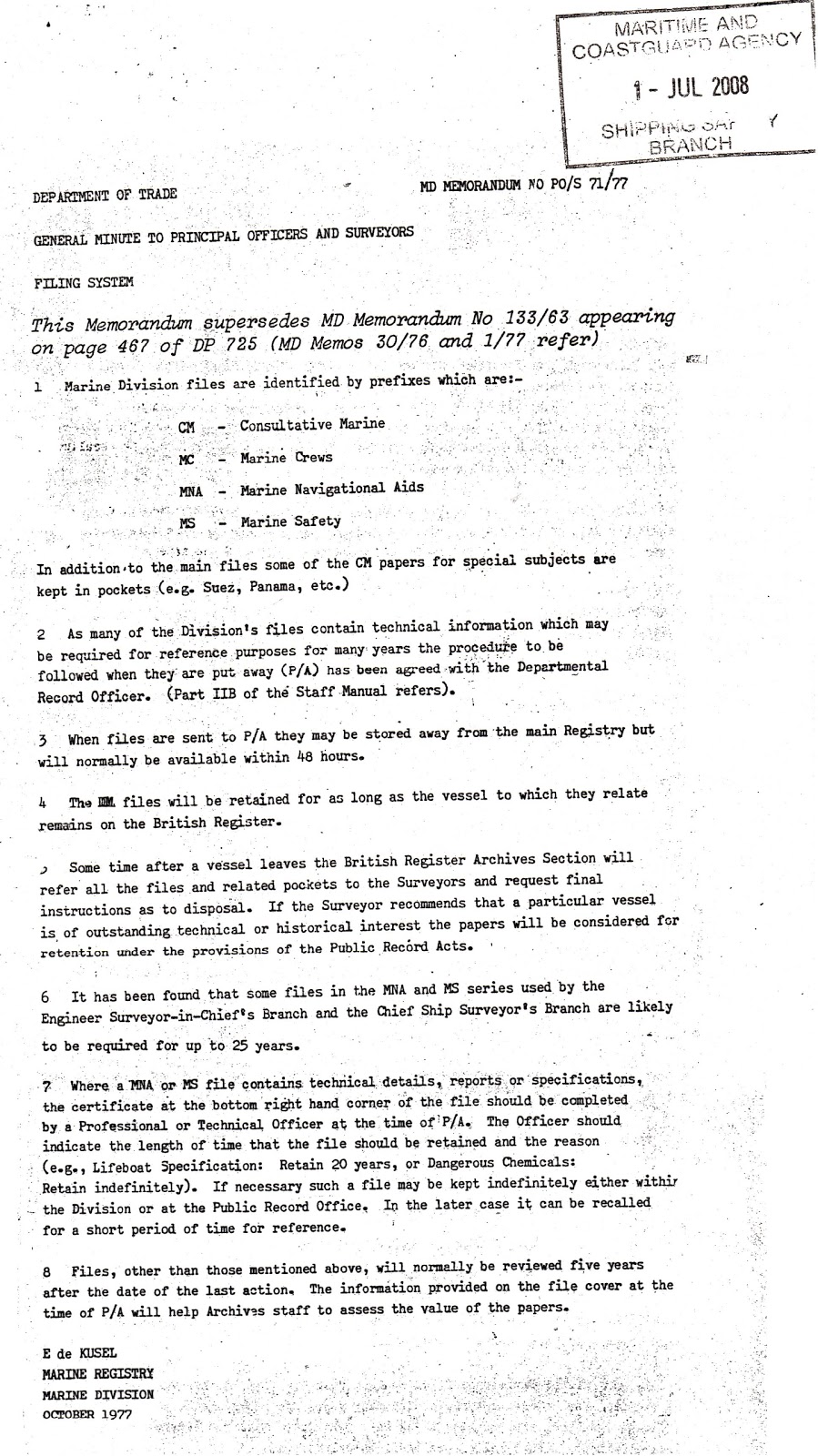
In the first instance, merchant shipping files do not go to the shredder by way of a mindless, automated routine; they are sent there when they are no longer relevant to current happenings in the shipping world (for MCA policies relating to file retention and disposal see copy of memorandum below – paragraphs 2, 5 and 7 are the most relevant. Note: files containing the results of expensive maritime safety research are not routinely shredded).


Additionally, the very fact that the wreck of the Trident was discovered in June 2001 and that the Marine Accident Investigation Branch (MAIB) were subsequently tasked with carrying out underwater surveys on it, meant that, in the first instance, the MAIB would have collected all available Trident files from the Department’s main file registry.
It was only after they had reviewed all official records and the results from their underwater surveys that the MAIB were able to advise the DfT’s Minister that ‘new and important evidence’ had been found - the basis on which Mr Stephen Byers re-opened the formal investigation in March 2002.

Once a maritime public inquiry has been opened (or re-opened), the normal procedure is for all official files and records to be taken into the custody of the DfT and AG (via the Treasury Solicitor) who will then decide which items of evidence should be released to the parties to the inquiry.

Thus, if the Trident investigation was re-opened in 2002 and the Trident stability file was shredded in 2005, it would seem that someone within the DfT specifically requested/authorised the file’s destruction. MCA officials would not have been authorised to take a decision on a file that was linked to an ongoing formal inquiry.

Perhaps the DfT could provide us with a justification for their haste.

(On this subject, there is, however, more to come…)

------------------------------------------------
[*]  By 2005, the DfT and their retained experts were well on course for a re-write of the official records on the Trident’s loss. Obviously, if there were any historical records available from that period – and if they fell into the 'wrong hands' (the FOI act came into force 6 weeks before the Trident’s records were shredded) - then these could be read!!!!

Saturday, October 02, 2010

Cowardice and other hindrances

Over the last four years we have published substantive evidence of a miscarriage of justice in the outcome of the Gaul Re-opened Formal Investigation, in which the Court decided that the crew had been responsible for the tragedy while conveniently ignoring serious faults in the vessel’s design and actively suppressing the evidence thereof.
Over the last four years we have dutifully brought these issues to the attention of all relevant authorities and succeeding governments. The past New Labour administrations, naturally, had no interest in addressing them.
But the newly installed government coalition promised us change – change that we understood would be for the better and, as we have recently made some progress (the Met Police had just become slightly more candid and the DfT a touch more sensitive to facts), we thought that appropriate action was forthcoming.


At the same time, however, the left-wing press turned the spotlight on some past minor scandals, rekindled and hyped up to provoke outrage and unsettle the present administration. (And irony of ironies, and amazing coincidence, old John Prescott, the main protagonist in the Gaul and Derbyshire re-opened investigations, was one of the first to jump onto the media circus bandwagon and, becoming suddenly aggrieved with some perceived past infringements to his privacy and loudly condemning the Police indifference to his claims, threatened them with costly legal action.)

All these irate attacks by the political opposition, though irrelevant to the general public, appear, nonetheless, to have made our government lose composure and falter in its commitment to rectify the errors of the past regime.

Failed inquiries, aborted investigations and other unexposed official transgressions seem nowadays to be like stashed away ammunition - ready for use in political battles - or some form of convertible currency, to be traded off on the black market of politics.
For, nowadays, government and political opposition are all part of the same intricate mesh, tightly tangled together in mutual interests, cowardice and ignominy.

P.S. We urge the Prime Minister, David Cameron, to start acting with integrity.

Monday, September 20, 2010

Police Investigative Methods

Following on from our post of 19 August 2010, in which we decried the fact that after a FOI request, one demand for an internal review and one complaint to the FOI team within the Information Commissioner’s Office, the mystery surrounding the content of paragraphs 8 to 18 in the assessment report complied by the Metropolitan Police in response to our allegations about the Gaul RFI remained unresolved.

Persistence, however, brought some results, for, after having submitted another complaint - this time to the Data Protection team within the Information Commissioner’s Office - the Met was forced to release their case assessment report - unredacted.

And what a letdown that was. The eleven paragraphs in question refer exclusively to our allegations in respect of the 2004 Gaul RFI, which they reproduce therein almost word for word. No personal data in there, except for our names mentioned once or twice. A copy of the Met’s unredacted report can be seen HERE.

The report contains no information to suggest that the Met contacted any witnesses or in any way probed the alleged facts.
Contrary to what we had expected, the Specialist Crime Unit in the Met does not appear to have even tried to obtain any further information about the case, by contacting for example, experts in the domain, the Department for Transport, the Gaul RFI legal teams, the Treasury Solicitor, the representatives of the victims’ families or any other witnesses.
The Met, although conceding in an addendum to their assessment report that "the Inquiry’s findings as to why various chutes were open are not necessarily correct" [LINK], chose not to pursue the matter any further.

At the end of their assessment, they concluded that, based on the information we had provided at that time, they were "unable to find sufficient evidence to support any further investigation into the allegation" and that they "did not detect fraud, any other crime, or any other matter which warrants any further Police investigation.".

Based on the same approach, the police could just as well refuse to investigate a murder and claim that, although it was reported that a person had been seen gunned down on the street, they did not visit the scene or verify any of the alleged facts, and that, therefore, there was insufficient evidence to suggest that a crime might have been committed.

Back in December 2008, in their first refusal to disclose the contents of their case assessment report, the Met argued that the disclosure would expose to the layman the "operational methodology and investigative techniques" of the Police. They were quite right. Now, that we’ve seen the unredacted report, we know precisely what these techniques really are.

Sunday, September 12, 2010

A trip down memory lane

Having recently leafed through some old books about the Gaul, we found an interesting paragraph at page 62 in John Nicklin’s book, The Loss of the Motor Trawler GAUL, which we have reproduced below.


Sadly, Mr Nicklin is no longer with us and will not be able to read copies of two of the official memos that were circulated at that time (see below). These memos provide the answer to his question as to why the Department of Trade, who had commissioned the NMI report on the Gaul, declined to make its findings public.


The last paragraph in the memo above shows that the Department of Trade were not prepared to permit the publication of the NMI report on the Gaul’s stability, for fear that its conclusions might provide evidence to one of the parties to the litigation.


The above memo shows that only after the prospect of litigation had disappeared did the NMI think it likely that the Department of Trade would grant permission to make the results of their research public.

Unfortunately, this is all we have time for at the moment, but we shall come back to this subject (and to the Trident affair) in due course.

Wednesday, August 25, 2010

Wreck Discovery

It has recently been reported that a team of divers have discovered the wreck of a UK fishing vessel thought to be the Blue Crusader, a 274 tons gross trawler which was lost in heavy weather (10-12 force gales) off Ronaldsay Firth in the Orkneys after sailing from Aberdeen on January 13, 1965. All 13 crew onboard perished in this tragedy.
After 13 days without radio communications from the vessel, a full-scale search was launched. Two Shackletons from Royal Air Force station Kinloss scanned the Orkneys area for four days, but the trawler was never found.

The identity of the wreck now discovered has not as yet been confirmed, but the diving team who located it are planning to go back to the site and check its registration number.

Meanwhile, we have found a copy of the Report of the Official Inquiry, dated 3rd December 1965, which can be viewed and downloaded from this LINK (Crown Copyright).

Note

In 1965 when the Blue Crusader was lost the regulatory framework, which governed the safety of fishing vessels was very weak. It was not until after the IMCO had developed their minimum standards for fishing vessels stability and the Holland-Martin Report on trawler safety had been published, that UK safety legislation, courtesy of the 1970 Safety Provisions Act, was put in place to rectify this shortfall.

Thursday, August 19, 2010

Personal Data

In an earlier post we disclosed a previously redacted paragraph from the Met Police (Specialist Crime Unit) case assessment report – to which we had recently gained access care of the Information Commissioner’s Office (ICO).

The report in question had been, as you can see from our post of 10 of May 2009, almost entirely redacted by the Met who claimed that: "the majority of information contained within the report has been redacted as it is exempt by virtue of Section 40(1)&(2) of the Act."
Section 40(1) of the Freedom of Information Act refers to the personal data of the subject data applicant, whereas Section 40(2) refers to the personal data of other people .[*]
Thus, the Met implied, over 80% of their assessment of the Gaul RFI consisted of biographic detail … (!?) although in their response to our FOI request for information regarding any witnesses/ parties questioned by detectives during their assessment process, the police indicated there were none.

The Met also advised that, should we wish to request the redacted information in respect of Section 40(1) (i.e. personal data about ourselves), which is contained in that report, we would have to complete a Subject Access Request (SAR) application.
We did complete two SAR forms and paid the associated fees. The response we got, however, was the release of another few lines from their case assessment report (these, except for our names, did not contain any other personal data, but only the allegations we had made about the shortcomings of the Gaul RFI).
The rest still remained concealed. That is a big chunk of the report – paragraphs 8 to 18 – remained redacted, purportedly, under the provisions of Section 40(2) of the Freedom of Information Act, which relates to third parties’ personal data.

Now, if we take another look at the redacted report, we can see that paragraph 19 states that the case officer "reviewed the materials described at paragraphs 10 to 18" in order to assess the validity of our complaint about the undisclosed design faults of the Gaul. The materials should, therefore, have contained technical rather than personal information. For, anyway, what personal information could they have contained and about whom? Under the 1998 Data Protection Act (DPA), personal data is clearly defined as data about a living individual, who can be identified from those data.
It may be that the documents referred to in the police assessment report did, in effect, contain information relating to technical matters, but - based on the fact that those materials had an author who, by necessity, must have been a living person, and judging that any expressed opinions reveal the insights of a person’s mind - the Met may have gone as far as to conclude that disclosure of such insights were prone to lead to undue intimacy and breach, therefore, the author’s rights under the Data Protection Act.


Thus, the Met have conveniently missed the fact that personal data is information about a person, not information a originating from a person – otherwise, except that produced by non-human species, all information would be exempt.
Also, as we have already contended in our reply to the Met, a witness statement is not considered personal data under the provisions of the 1998 Data Protection Act, unless the witness himself is the focus of that information. Just because a document contains the name of a person does not mean that it is about that person.
All opinion has an author, but if the opinion is not about the author himself and his personal life, then that opinion should be able to be passed on. Besides, the Data Protection Act itself suggests the means by which information can be conveyed without revealing its source: i.e. the omission of names or other identity details.

Unfortunately, by choosing not to disclose the requested information, the Metropolitan Police have now left room for suspecting that the content of their case assessment report is either embarrassing or untrue.
---------------------------------------------------------------

[*](1) Any information to which a request for information relates is exempt information if it constitutes personal data of which the applicant is the data subject.
(2) Any information to which a request for information relates is also exempt information if-
(a) it constitutes personal data which do not fall within subsection (1), and
(b) either the first or the second condition below is satisfied. [etc]

Wednesday, August 04, 2010

The FV Trident Investigation – Another Public Inquiry - Another national disgrace

In an earlier post we gave an overview on how the re-opened Trident casualty investigation (RFI) was being conducted and managed by the Advocate General towards an outcome that would be preferred by at least one of the departments in our current Government (the DfT).


Recently we have learnt that the JPE (the RFI’s Joint Panel of Experts) had also taken it upon themselves to rewrite the official records of Trident’s intact stability.

Work done:

The JPE have changed the official DOT lightship particulars for Trident (from those used in the original investigation):

Original investigation (OFI) 1975

Lightship displacement[1] = 149.83 tonnes (147.46 imperial tons)
VCG[2] position = 3.197m above keel (10.487 feet)
LCG[3] position = 9.971m forward of the rudder stock (3.525 feet aft of amidships)

Re-opened investigation (RFI) 2010

Lightship displacement = 153.01 tonnes
VCG position = 3.18m above keel
LCG position = 9.95m forward of the rudder stock

They have also modified the weights of the items that she was assumed to be carrying on the day of her last voyage (the original figures can be seen in the NMI/Morrall testing report page 13 and in the report of the original investigation - condition A2):
  • They increased the amount of fuel she was carrying by 1.75 tonnes to 6.75 tonnes
  • They doubled the amount of fresh water on board to 3 tonnes
  • They reduced the amount of stores in the upper focsle space from 1.5 tonnes to 0.45 tonnes and removed 1 tonne of stores from the lower focsle space
  • They reduced the weight of the fish boxes in the hold from 3.37 tonnes to 2.4 tonnes
  • They reduced the weight of the lube oil drums in the engine room by 20kg
  • They reduced the weight of fishing nets from 3.6 tonnes to 3 tonnes
  • They increased the weight of the gallows chain from 0.27 to 0.45 tonnes
  • They removed the ‘dog rope’
  • They increased the amount of engine room stores by 100kg
  • They increased the amount allowed for the crew’s effects by 90kg
In brief, the effect of the JPE’s modifications has been to increase Trident’s notional stability reserves[4] by about 10% for her final sailing and loss condition.

If we look at the stability of the Trident in both the original and the JPE-modified conditions we can see that in her original condition, Trident is clearly non-compliant with IMCO minimum stability criteria, however, after the JPE modifications have been applied, her stability improves to the point where she only marginally fails to meet the IMCO minima:


What were the motives behind the JPE’s actions?

1. To ‘update’ our official records to indicate that, contrary to the evidence contained in the report of the 1975 formal investigation and in the 1976 NMI/Morrall report, the Trident’s stability at the time of her loss 'complied substantially with IMCO'[5] minimum standards, and that, therefore, non-compliance was not a factor in her loss.

(RFI Transcript for 12 July 2010 – Advocate General page 102:)


2. To request the Sheriff to dismiss the conclusions from the original 1975 formal investigation and the subsequent model tests carried out NMI/Morrall in 1976;

(RFI Transcript for 12 July 2010, page 105:)


3. And finally to oblige the Sheriff to conclude:

(RFI Transcript for 12 July 2010, page 74)


Our conclusion

The callous way in which the current investigation into the tragic loss of the Trident and her seven crew members has been scripted by the DfT and conducted by the AG towards a pre-determined outcome reveals the depths that our Government, and those it employs, will stoop in order to maintain policies that, regardless of their warped perception of the public interest, they know are both unjust and unlawful.

This is nothing less than a national disgrace

An extended pdf version of this article is available HERE.

-------------------------------------------------------------
[1] Lightship displacement = the floating weight of the empty ship
[2] VCG = the position of the vertical centre of gravity of the ship’s weight
[3] LCG = the position of the longitudinal centre of gravity of the ship’s weight
[4] Note:  In 1975, the Court’s experts carried out a very comprehensive and careful investigation into Trident’s stability characteristics - in terms of ascertaining her empty hull weight, position of centre of gravity and the items of fishing gear, fuel, water and stores she was carrying onboard at the time of her loss. There is no substantive reason or factual basis to justify the changes that have now been carried out by the JPE.
[5] This was the stated position of the DOT throughout the 1975 Formal Investigation