Showing posts with label Burness Corlett. Show all posts

Monday, September 14, 2009

FV Trident – the upcoming court drama

The FV Trident inquiry is expected to start in October this year. Meanwhile, relatives of the crew, it has been announced, will submit an expert [1] report suggesting that stability problems were a contributing factor to the capsize and loss of the vessel.
There is also, of course, the official joint report, compiled by a 14-man expert panel, which, we are told, attributes the loss of the Trident to ‘seakeeping problems’.
These differences of opinion on what caused the tragedy are likely to add further delays to the formal inquiry.
Although we have not seen either of the above-mentioned reports, we would like to venture a couple of preliminary observations on the subject:
First, the seakeeping ability of a vessel - which the panel of experts in the Trident inquiry are geared up to blame for the tragedy - is a composite notion, vague enough and large enough to embrace a number of possibilities. Unlike stability, there is no agreed or regulatory yardstick attached to ‘seakeeping’ above which a vessel can be deemed to be safe. Hence, pointing the finger at seakeeping is almost like saying that the vessel did not perform well, that something was wrong with the vessel, without explaining what that was.
In such a case, it is to be expected that cause and effect and, therefore, blame and liability would be rather difficult to establish. [2]
And second, it would be very unfair if the expert reports attached to this public inquiry were not to be made public. Having paid, so far, no less than £3 million for the research into the causes of the Trident disaster, the taxpayer deserves full access to that information.
Anyway, as we have mentioned before, we will be taking a keen interest in the developments of this inquiry, and we hope that officialdom will not be tempted to try their luck again and replicate the travesties of justice that were the Gaul and Derbyshire formal inquiries.
----------------------------------------------------------------------------------
[1] Expert report on stability deficiencies by Mr Martin Pullinger, naval architect with over 30 years of experience with Burness Corlett & Partners – a marine consultancy firm who provided technical advice to the Gaul and Derbyshire formal investigations.
[2] This is perhaps the first indication of possible government interference in what should be an impartial technical process.

Tuesday, April 01, 2008

Elastic conclusions or the re-writing of history

In an earlier POST we already mentioned one embellishment contained in a paper produced by the experts in the 2004 Gaul RFI
In that same paper, drawn up as a summary of the results of the formal investigation, the experts also went a step beyond the official findings and stated with conviction:
“There was no logical reason why the duff and offal chute lids were secured in the open position, whilst dodging, other than crew error. It is also difficult to understand why the flap valves were jammed in the open position other than bad maintenance onboard or ashore.”
The authors were, of course, well aware of the fact that the offal chute lids had not been found secured in the open position. They were also aware that it was only around the duff chute lid that some kind of ‘ligature’ had been seen hanging and, therefore, one could not truthfully say that both the duff and the offal chute lids had been secured open by the crew of the Gaul.
The RFI final report, having been drawn up by better-versed legal minds, went only as far as advising that:
“In the case of the duff chute, the single lid was apparently secured in the open position by some form of ligature and in the case of the offal chute the split lid was found with the forward half open and the aft half closed, but not secured.”
The RFI experts must have also realised that any future interested parties would be more likely to read their free paper rather than the costly and voluminous RFI report, and that their words may therefore be taken as fact.
In the light our previous post and the above observations we would ask our readers the following question: What can one make of these exaggerations, which, it so happened, had the effect of adding undeserved weight to the Court’s ‘crew error’ verdict?

Friday, December 07, 2007

Hyperbolic representation

On 25 January 2006, the Gaul RFI experts panel presented a paper entitled ‘The Loss of the M.F.V Gaul’ (see http://www.bctq.com/downloads/Gaul.pdf) to the Royal Institution of Naval Architects. This paper - a summary on the work the experts had concluded during the 2004 RFI - flatly states:
There was no logical reason why the duff and offal chute lids were secured in the open position, whilst dodging, other than crew error. It is also difficult to understand why the flap valves were jammed in the open position other than bad maintenance onboard or shore.”
Familiar perhaps with the old wisdom that a good slogan can stop fifty years of analysis, or maybe emboldened by the calm passage of time, the Gaul experts claimed in their paper more certainty for the results of the 2004 RFI than the course of the proceedings ever warranted, and confidently put forward a more unequivocal explanation for the open state of the chutes’ inner lids.
Thus, what justice Steel and his associates had delicately implied at the end of the RFI, fourteen months later, the experts laid down in more explicit language, adding extra detail, specificity and emphasis to what the legal staff had left unsaid.
Had our Gaul experts been more scrupulous in checking their notes, the RFI transcripts of evidence and the final report, they would have remembered that the duff and offal chutes’ lids had not actually been found secured in the open position. Though, of course, the implication that the lids had been found so allowed the crew error/negligence label to be much more easily attached.

Wednesday, November 08, 2006

Sister Vessels

Yesterday we received a letter from the DfT purporting to answer our previous queries. We will publish it on this site and comment on its contents shortly. For starters, we are addressing the department’s inference that there was no design defect on the Gaul, because the sister vessels, with the same design, did not sink.
“… it should be remembered that the FV Gaul and her sister ships were built under Lloyd’s approval, with the same duff and offal chutes design. On the sister ships these chutes survived under similar conditions and were retained until the end of their service.” (Letter from the DfT dated 07.11.06)
The above comments imply that the duff and offal chutes gave satisfactory trouble free service throughout the lives of the sister vessels. A closer look into this matter shows that, in fact, this is not quite the case:
The Gaul had three sister vessels: Arab, Kelt and Kurd. These vessels are still in service, but none is currently working as a trawler.
Available records show:
1. That the Kappin (ex Arab) is currently working as a fish processing factory freezer ship off the Greenland coast.
The Arab was sold in 1983 and converted into a support depot ship for submersibles; in 1984 it was converted back into a stern trawler. The vessel continued to work as a stern trawler until early 2006 when it was converted into a fish factory ship.
A very good photo of this vessel can be viewed at:
http://www.shipspotting.com/modules/myalbum/photo.php?lid=235426
The vessel was visited in 2003, by the retained experts for the RFI for the purposes of obtaining information that could be of use to the Investigation. The vessels crew were also quizzed at that time (ref. Technical paper presented by the retained experts ‘The loss of the MFV Gaul’ - http://www.bctq.com/isleman.html)
“As part of the RFI, a party visited the FV KAPPIN, a sister vessel to GAUL still fishing from the Faroes. Discussion with the crew revealed that flooding of the factory deck was a recurrent problem. This had been dealt with in part by installing deep well pumps and blanking off the forward offal chute. Even so, crew recounted serious flooding incidents as a direct result of water coming through the aft duff chute. Fortunately this was never catastrophic.”
Does this mean that the crew of the Kappin have also been leaving the chute flaps and covers open?
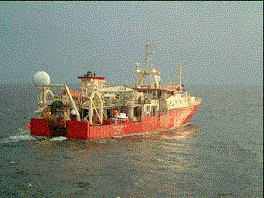
2. That the Bergen Surveyor (ex Kelt) is currently working as a seismic survey vessel for Norwegian owners.
The Kelt was sold in 1982 and initially converted into a support depot ship for submersibles; in 1997 it was converted into a seismic survey vessel.
A very good photo of this vessel can be viewed at:
http://www.shipspotting.com/modules/myalbum/photo.php?lid=63966
It is most likely that the duff and offal chute openings would have been removed at the time of time of its initial conversion in 1982 (support vessels do not need arrangements for the discharge of duff and offal). The picture shows that, in its current guise, the chute openings are no longer present.
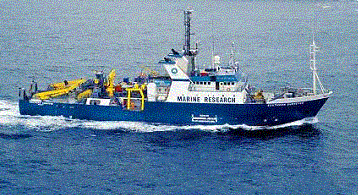
3. That the Southern Surveyor (ex Kurd) is currently working as a marine research vessel and is owned by the Australian Government. The factory deck on this vessel has been converted into a laboratory.
The Kurd was sold in 1983 and initially converted into a support depot ship for submersibles; in 1988 it was converted into a research vessel.
A very good photo of this vessel can be viewed at: http://www.marine.csiro.au/nationalfacility/images/1shipside_lge.jpg
It is most likely that the duff and offal chutes would have been removed at the time of its initial conversion in 1983. The picture above shows that, in its current guise, the chute openings are no longer present.