On 10 October 2009, a crewmember onboard the scallop dredger Olivia Jean was injured when a trawl wire parted and he was hit by a falling bridle. The fisherman sustained chest injuries and was subsequently airlifted to hospital
Following that accident the MAIB carried out a detailed safety audit onboard the Olivia Jean and a number of regulatory non-compliances, including stability deficiencies, were identified,
The Maritime and Coastguard Agency (MCA) were notified and they also inspected the vessel; however, they subsequently permitted the Olivia Jean to continue fishing even though the official limits in her trim and stability book were regularly being exceeded [1].
As a consequence, the MAIB issued Safety Bulletin No 1/2010, which called on the Olivia Jean’s owner to cease fishing operations immediately and on the MCA to:
Ensure that the stability of Olivia Jean (TN 35) is verified and all safety critical limitations are applied before allowing further fishing operations to take place
The release of this safety bulletin, critical of MCA, was an unusual action for the MAIB to take as generally both MAIB and MCA worked together and supported one another (both being part of the maritime section of the Department for Transport).
Perhaps the MAIB were remembering previous scallop dredger losses – the Pescado in 1991 (where six men died) and the Solway Harvester in 2000 (where seven men died) and were concerned that stability deficiencies on yet another scallop dredger could lead to another tragedy.
The MAIB would also have been mindful of the fact that in 2006 when they had published the Solway Harvester report they had been obliged, once again [2], to tidy up a mess left for them by MCA, which they did by skipping over the Solway Harvester’s stability deficiencies.
Stability Standards
Extracts from the MAIB’s casualty reports for the Olivia Jean and the Solway Harvester are reproduced below, where the stability of each vessel has been assessed by MAIB for compliance with minimum stability standards.
Olivia Jean
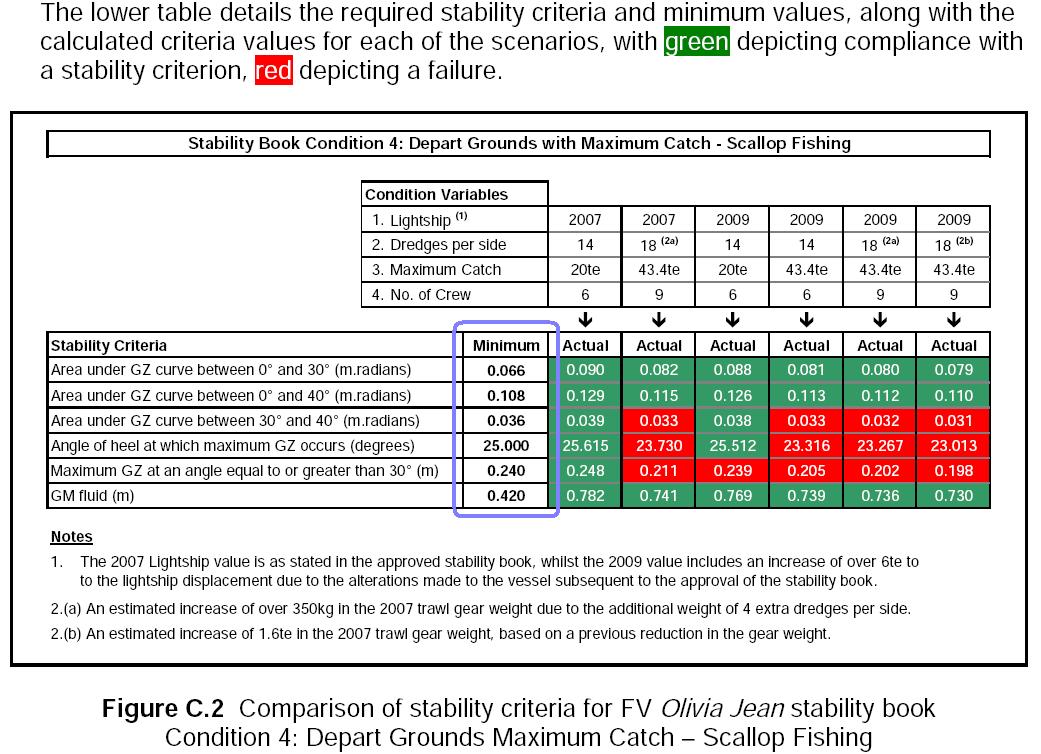
MAIB’s stability assessment - they compared Olivia Jean’s actual stability reserves against the official stability minima (ringed in purple); these minimum criteria include the 20% stability enhancement that is required for scallop dredgers. In the example shown here, the Olivia Jean fails to meet the required stability standard in the ‘depart grounds’ sailing condition.
Solway Harvester – stability curve for the loss condition
The Solway Harvester’s marginal stability reserves and poor GZ values are clearly visible from this curve:


MAIB’s stability assessment – they compared the Solway Harvester’s estimated stability reserves against the minimum stability criteria ringed in purple above; however, these minimum stability criteria, chosen by the MAIB for comparison purposes, are different from the criteria they used for the Olivia Jean – they are the wrong criteria as they do not include the 20% stability enhancement that is required for scallop dredgers and beam trawlers. However, by comparing the Solway Harvester’s stability values against a lower stability standard, the MAIB were able to say that she ‘passed’ the requirements (the figures reveal a marginal pass of the lesser stability standard).
The MAIB were aware that they were on shaky ground here and, when they published their report on the Solway Harvester’s loss, the important part within their report - where the minimum stability criteria were identified - was barely legible as well as very carefully worded.
They talk about “compliance with regulations”, yet they do not identify which specific regulations the vessel allegedly ‘passed’.
It certainly didn’t meet the regulations applicable to scallop dredgers (i.e. Rule 16 of the Fishing Vessels Safety Provisions Rules 1975 with the 20% increase in stability for fishing vessels engaged in twin boom fishing).
Moreover, it is also highly likely that, given the number of questionable assumptions made by the MAIB in their calculations for the Solway Harvester’s loss condition, she did not even comply with the lesser stability standards either.

Solway Harvester
In the above image (c/o STV website), the Solway Harvester can be seen sailing in a deeply laden condition where her freeboard and stability reserves are clearly suspect. In the above image, the blue arrow indicates the position of her watertight main deck – only just above the sea-surface.
It should be noted that Solway Harvester’s design allowed seawater to freely enter the non-weathertight steel enclosures and wash across her decks.
If, as shown in the sketch below, the non-weathertight enclosures are removed, the watertight hull and three-weathertight superstructures become apparent. The main deck is only just above the sea-surface (arrowed) and thus, when the above photo was taken, the only things keeping the vessel afloat and upright at that time were the meagre buoyancy reserves provided by the small part of her hull above seawater and the three small superstructures.

MAIB report no. 1/2006
Concluding remarks
If, on 11 January 2000, the Solway Harvester had complied fully with official stability standards it is just possible that, she would not have succumbed to the weather and capsized with the loss of all onboard.
---------------------------------------------------------------
[1] The MCA have sole responsibility for statutory surveys, stability approval and the issue of fishing vessel safety certification on UK fishing vessels.
[2] The MAIB have had to investigate and report on a number of fishing vessel casualties where the MCA’s ‘light regulatory touch’ has been an obvious factor in the loss.


