Showing posts with label MCA. Show all posts

Thursday, November 24, 2011

Another whistleblower

Apart from the naval architect whose disclosures have been published on this blog over the last five years, the Department for Transport, the Maritime and Coastguard Agency more precisely, were blessed with another whistleblower. The latter, Mr Jayan Pillai, an article in the Private Eye (see below) informs us, raised concerns about the MCA’s flexible approach towards the registration of ships with fire-fighting arrangements that fell short of the international seagoing safety standards.

The Department has not owned up to anything yet and has decided to fight them both - a move, which, we suspect, is going to be associated with a lot of mess.

 (article c/o Private Eye, No.1300, 28 October 2011)

The DfT/MCA, it seems, have made rather a hobby of plastering over the cracks, and, although in a small MCA branch there once existed two whistleblowers, within the organisation itself, there is certainly scope for many more.

Saturday, July 23, 2011

Stability standards for scallop dredgers - Solway Harvester and Olivia Jean

On 10 October 2009, a crewmember onboard the scallop dredger Olivia Jean was injured when a trawl wire parted and he was hit by a falling bridle. The fisherman sustained chest injuries and was subsequently airlifted to hospital

Following that accident the MAIB carried out a detailed safety audit onboard the Olivia Jean and a number of regulatory non-compliances, including stability deficiencies, were identified,

The Maritime and Coastguard Agency (MCA) were notified and they also inspected the vessel; however, they subsequently permitted the Olivia Jean to continue fishing even though the official limits in her trim and stability book were regularly being exceeded [1].

As a consequence, the MAIB issued Safety Bulletin No 1/2010, which called on the Olivia Jean’s owner to cease fishing operations immediately and on the MCA to:
Ensure that the stability of Olivia Jean (TN 35) is verified and all safety critical limitations are applied before allowing further fishing operations to take place

The release of this safety bulletin, critical of MCA, was an unusual action for the MAIB to take as generally both MAIB and MCA worked together and supported one another (both being part of the maritime section of the Department for Transport).

Perhaps the MAIB were remembering previous scallop dredger losses – the Pescado in 1991 (where six men died) and the Solway Harvester in 2000 (where seven men died) and were concerned that stability deficiencies on yet another scallop dredger could lead to another tragedy.

The MAIB would also have been mindful of the fact that in 2006 when they had published the Solway Harvester report they had been obliged, once again [2], to tidy up a mess left for them by MCA, which they did by skipping over the Solway Harvester’s stability deficiencies.

Stability Standards

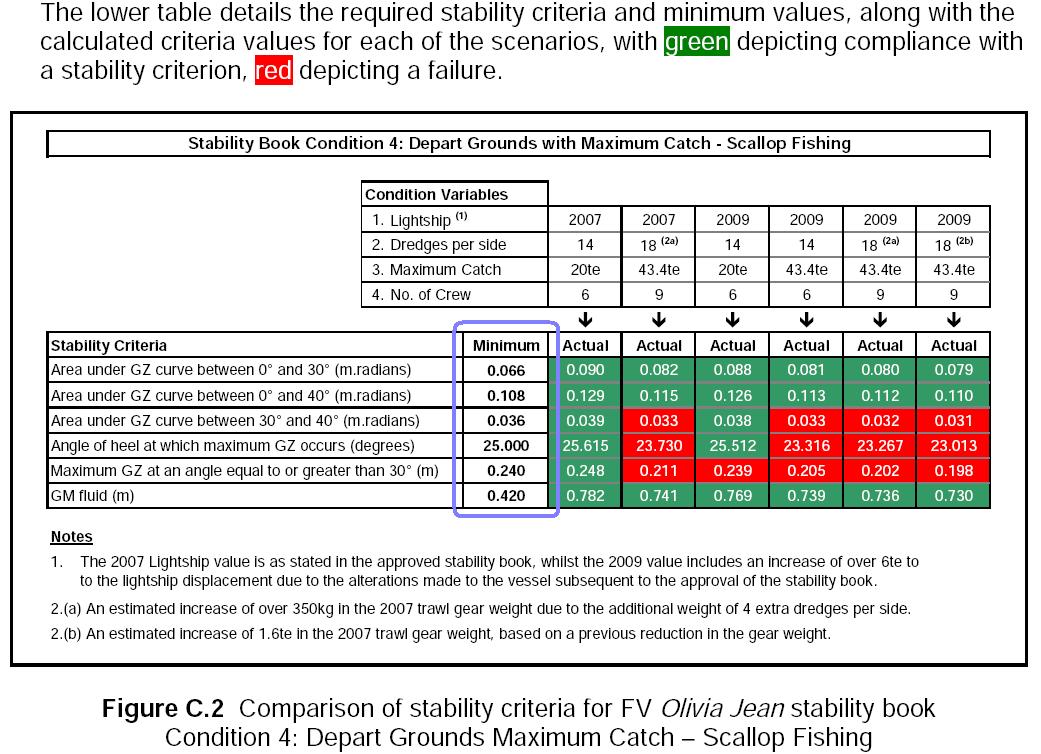
Extracts from the MAIB’s casualty reports for the Olivia Jean and the Solway Harvester are reproduced below, where the stability of each vessel has been assessed by MAIB for compliance with minimum stability standards.

Olivia Jean


MAIB’s stability assessment - they compared Olivia Jean’s actual stability reserves against the official stability minima (ringed in purple); these minimum criteria include the 20% stability enhancement that is required for scallop dredgers. In the example shown here, the Olivia Jean fails to meet the required stability standard in the ‘depart grounds’ sailing condition.

Solway Harvester – stability curve for the loss condition

The Solway Harvester’s marginal stability reserves and poor GZ values are clearly visible from this curve:


MAIB’s stability assessment – they compared the Solway Harvester’s estimated stability reserves against the minimum stability criteria ringed in purple above; however, these minimum stability criteria, chosen by the MAIB for comparison purposes, are different from the criteria they used for the Olivia Jean – they are the wrong criteria as they do not include the 20% stability enhancement that is required for scallop dredgers and beam trawlers. However, by comparing the Solway Harvester’s stability values against a lower stability standard, the MAIB were able to say that she ‘passed’ the requirements (the figures reveal a marginal pass of the lesser stability standard).

The MAIB were aware that they were on shaky ground here and, when they published their report on the Solway Harvester’s loss, the important part within their report - where the minimum stability criteria were identified - was barely legible as well as very carefully worded.

They talk about “compliance with regulations”, yet they do not identify which specific regulations the vessel allegedly ‘passed’.
It certainly didn’t meet the regulations applicable to scallop dredgers (i.e. Rule 16 of the Fishing Vessels Safety Provisions Rules 1975 with the 20% increase in stability for fishing vessels engaged in twin boom fishing).

Moreover, it is also highly likely that, given the number of questionable assumptions made by the MAIB in their calculations for the Solway Harvester’s loss condition, she did not even comply with the lesser stability standards either.

Solway Harvester

In the above image (c/o STV website), the Solway Harvester can be seen sailing in a deeply laden condition where her freeboard and stability reserves are clearly suspect. In the above image, the blue arrow indicates the position of her watertight main deck – only just above the sea-surface.

It should be noted that Solway Harvester’s design allowed seawater to freely enter the non-weathertight steel enclosures and wash across her decks.

If, as shown in the sketch below, the non-weathertight enclosures are removed, the watertight hull and three-weathertight superstructures become apparent. The main deck is only just above the sea-surface (arrowed) and thus, when the above photo was taken, the only things keeping the vessel afloat and upright at that time were the meagre buoyancy reserves provided by the small part of her hull above seawater and the three small superstructures.

MAIB report no. 1/2006

Concluding remarks

If, on 11 January 2000, the Solway Harvester had complied fully with official stability standards it is just possible that, she would not have succumbed to the weather and capsized with the loss of all onboard.

---------------------------------------------------------------
[1] The MCA have sole responsibility for statutory surveys, stability approval and the issue of fishing vessel safety certification on UK fishing vessels.
[2] The MAIB have had to investigate and report on a number of fishing vessel casualties where the MCA’s ‘light regulatory touch’ has been an obvious factor in the loss.

Thursday, June 02, 2011

HM Courts and Tribunals

Following up from our post of 25 May 2011, we can now advise that the Case Management Discussion (CMD) mentioned there took place on the 27th of May, as scheduled.

The Department for Transport (and the MCA), the Respondents in the case, always liberal with taxpayers’ money, had hired a top-notch lawyer for the event. This barrister (who also sits as a judge) - a slightly fresher version of Justice Eady - has recently been given notoriety by the Daily Mail – as a gagger.

The CMD, unbefittingly called a ‘discussion’, consisted of the Respondents’ Counsel giving directions to the judge and the judge showing little resistance in following them, while the Claimant, accommodated with ostensibly dissimulated impatience, was hardly allowed to speak. The barrister hired by the DfT looked so upset that it was hard to believe that he was simply acting on the government’s behalf. The judiciary may have been closing ranks, we reckoned, bearing in mind that the Claimant’s disclosures have cast doubt on the integrity of a number of prominent figures within the judicial brotherhood.

What felt stranger, however, was the impression we got that the judge presiding over the CMD seemed somehow afraid of the government’s Counsel, and even took the cue from him as to when to take a break and when to adjourn.
Their plan was to remove the DfT from the proceedings, probably, so as to cut short the liability chain and ‘ring-fence’ the wrongdoing at some junior level within the MCA. Warned that trying to push her arguments forward will be sanctioned by the Court, the Claimant’s representative used the few moments when she was directed to give yes or no answers to a couple of questions to try to object to the Tribunal’s steamroller technique. At one such moment, she tried to suggest that not only the DfT, but also the Crown and former DPM John Prescott should be added as Respondents, a suggestion that was met with instant opposition from the judge and an indignant snort from the DfT’s barrister. The matter, however, was left unresolved.

Further on, the DfT’s Counsel demanded that a deposit be paid before the full hearing so as to make the access to justice more difficult – justice, it seems, is not a luxury for the plebs. The opposing party was prepared to do anything to prevent a full hearing where evidence, witness testimonies and the thorny matter of the Gaul could be heard in open court.

The end of the CMD was marked by the DfT’s Counsel delivering a diatribe against his opponent and the judge’s failure to intervene or to allow the Claimant to respond.
A pre-hearing review has been scheduled for the 11th of July and a full hearing for the 17th of October. But we very much doubt that there is much to expect from our justice system. The whole thing is rotten to the core.

Monday, February 28, 2011

FV Trident RFI - A question


We have a question that nobody seems willing to answer and which is: why nobody from the Department for Transport, the Maritime and Coastguard Agency, MAIB and the former DOT was ever called to give evidence under oath during the Trident RFI hearings?

Wednesday, December 08, 2010

FV Trident Inquiry - The MAIB leaves no traces

As we announced in our post of 15 November 2010, we lodged a FOI request with the Marine Accident Investigation Branch (MAIB) of the Department for Transport asking them a few simple questions aimed at clarifying their role in the FV Trident Investigation.

The response from MAIB, which we received yesterday does not clarify anything. What is more, it gives the false impression that the MAIB did not play any technical role (or keep any records of its role) in the run up to the Trident RFI, and goes on to suggest that, even if it had played such a role, this ought to remain an official secret.
To bolster their equivocation, the MAIB misinterprets the Merchant Shipping (Accident Reporting and Investigations) Regulations 2005 and tries to apply the prohibition clause therein, not only to the content of restricted documents or evidence[*], witness statements, or the personal details of any persons making such statements, but also to the question of whether they hold such evidence in their coffers.
Notable, however, is their reluctance even to address our query about any advice the MAIB might have provided to the DfT and the Office of the Advocate General for Scotland, in the run up to the Trident RFI.

As this blog bears witness, we have had encounters with the MAIB before, in connection with the Gaul investigation, and they were just as unhelpful. So it does not surprise us in the slightest to read their attempt at obfuscation in the Trident case now.

Well, as they say, 'once your reputation’s gone, you can live a life of fun'. And this is the obvious trend in most of our governmental institutions today.

---------------------------------------------------------------
[*] The Sheriff presiding over the FV Trident RFI has, nevertheless, the powers to call for such prohibited documents and evidence.
 

Monday, November 15, 2010

FV Trident Investigation - the role of the MAIB

So far, the Marine Accident Investigation Branch (MAIB) has been sheltered from the strong winds blowing around the ongoing Re-opened Formal Investigation into the loss of  FV Trident.

However, we know that, prior to the re-opening of this new investigation, the MAIB played an important role in assessing the causes behind Trident's loss.  We have now sent them a Freedom of Information request that, hopefully, will shed some light upon the official handling of this case.

NOTE: In the Gaul RFI, the MAIB produced a detailed report (Rep no.4/99) which accompanied their recommendation for a re-opening of the Gaul investigation. It is therefore to be expected that at least the same level of service and transparency should have applied in the Trident inquiry.

Sunday, October 17, 2010

FV Trident Inquiry – Shredding the evidence

An article published in the Press and Journal on 8 September 2010 informed the public about the outcome of the Trident families’ quest for information relating to a hidden NMI report on the Trident’s stability reserves (withheld from them by the Department for Transport (DfT) since 1976).

In a statement from DfT’s current Shipping Minister, Mike Penning, the families were told that it would now be “impossible” to establish the reasons why the report had not been passed over to them in 1976, when it was first produced.

Following a request for further information about this report (information that would have been located within the DfT’s shipping safety research folder - reference no. MS/92/12/09), the families were told that “this file is no longer in existence, it did not disappear, but was destroyed in accordance with the routine, approved disposal agreement” (?!) and that ‘A file is reviewed after 25 years and if National Archives show no interest in maintaining the file, then it is destroyed”

On hearing this news, the families were quite right to register a complaint, but, unfortunately, the task of dealing with it was given to one of the DfT’s divisional directors, a Mr John Bagley, who piously claimed:

“It is clear from documents supplied to me that on 17 February 2005 the MCA instructed Iron Mountain to destroy this file. The file was listed along with 9,777 others in the same instruction and appears to have been a routine procedure, which Iron Mountain complied with the following day when the file was destroyed by shredding. The file appears to have been disposed of in accordance with proper procedures and at a point in time which would have been well in excess of the retention period”

A plausible, but unfortunate set of circumstances perhaps, or bad luck? - We think not!! [*]

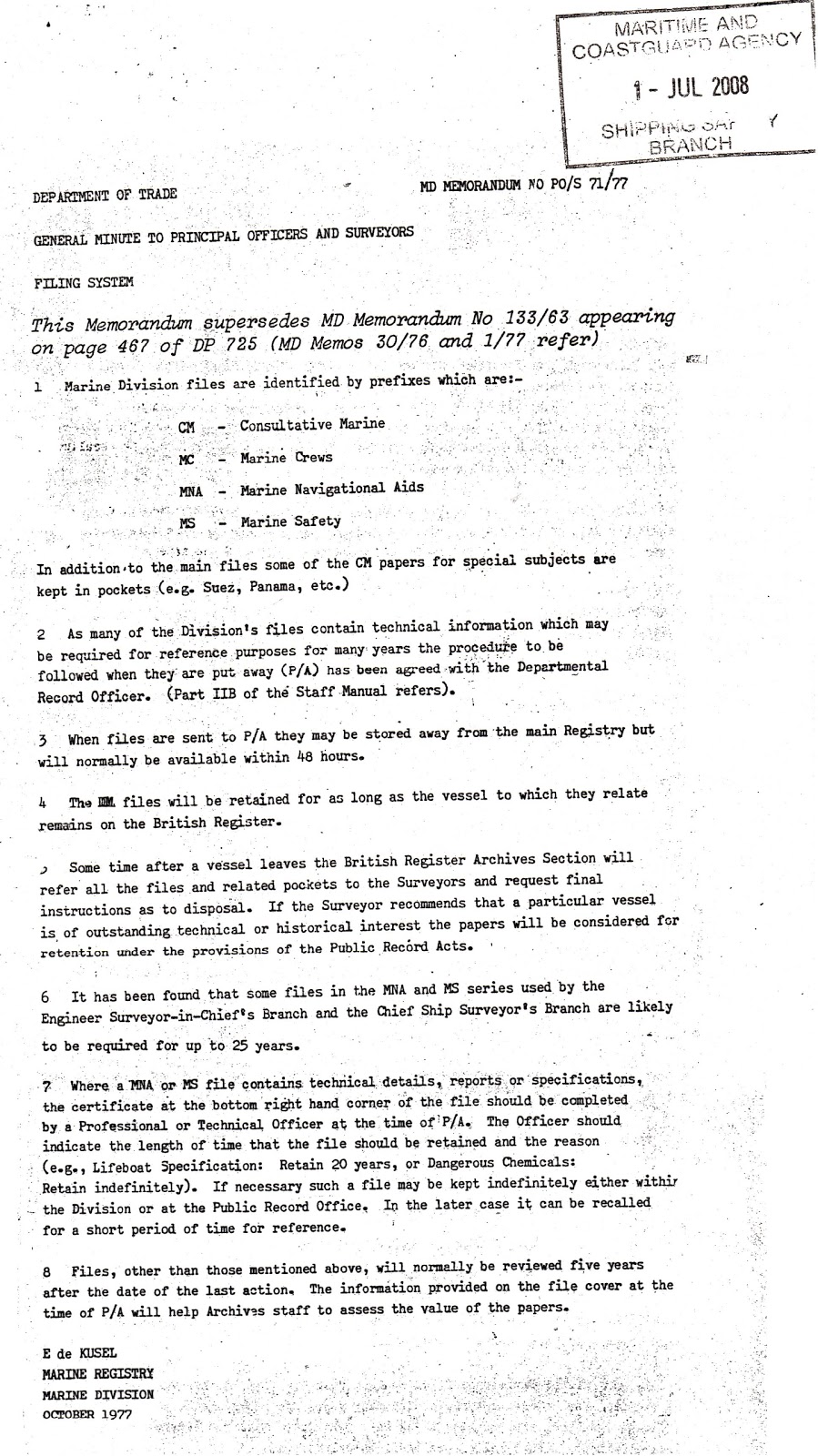
In the first instance, merchant shipping files do not go to the shredder by way of a mindless, automated routine; they are sent there when they are no longer relevant to current happenings in the shipping world (for MCA policies relating to file retention and disposal see copy of memorandum below – paragraphs 2, 5 and 7 are the most relevant. Note: files containing the results of expensive maritime safety research are not routinely shredded).


Additionally, the very fact that the wreck of the Trident was discovered in June 2001 and that the Marine Accident Investigation Branch (MAIB) were subsequently tasked with carrying out underwater surveys on it, meant that, in the first instance, the MAIB would have collected all available Trident files from the Department’s main file registry.
It was only after they had reviewed all official records and the results from their underwater surveys that the MAIB were able to advise the DfT’s Minister that ‘new and important evidence’ had been found - the basis on which Mr Stephen Byers re-opened the formal investigation in March 2002.

Once a maritime public inquiry has been opened (or re-opened), the normal procedure is for all official files and records to be taken into the custody of the DfT and AG (via the Treasury Solicitor) who will then decide which items of evidence should be released to the parties to the inquiry.

Thus, if the Trident investigation was re-opened in 2002 and the Trident stability file was shredded in 2005, it would seem that someone within the DfT specifically requested/authorised the file’s destruction. MCA officials would not have been authorised to take a decision on a file that was linked to an ongoing formal inquiry.

Perhaps the DfT could provide us with a justification for their haste.

(On this subject, there is, however, more to come…)

------------------------------------------------
[*]  By 2005, the DfT and their retained experts were well on course for a re-write of the official records on the Trident’s loss. Obviously, if there were any historical records available from that period – and if they fell into the 'wrong hands' (the FOI act came into force 6 weeks before the Trident’s records were shredded) - then these could be read!!!!

Wednesday, October 31, 2007

The closed system

“The Department is satisfied that there is no reason to doubt the outcome of the expert analysis that led to the Re-opened Formal Investigations conclusions and consequently there is no reason to re-open the investigation,” says the message sent to us by the Department for Transport on 8 October 2007.
So, the DfT are still proclaiming their faith in the merits of the 2004 Gaul RFI which, it is no longer a secret, did not lead to anything, except injustice and frustration, driving the whole purpose of a formal investigation onto precarious ground.
“You have informed me that the technical report, related documents and information published on the following sites: http://the-trawler-gaul.blogspot.com and www.freewebs.com/inconvenientcitizen, had been viewed by technical experts within the DfT before your latest decision not to re-open the investigation was taken.
I would therefore be grateful if you could tell me who these in-house experts are.”
We gently inquired the very same day.
Well, the DfT have, so far, been unable to give us the reply. They need, it seems, legal advice on how to answer the question.
Why take such precautions? We had only asked for the names of the experts involved… Is it because no in-house technical specialists have been in fact consulted? The DfT draw their technical expertise from agencies such as MCA and MAIB. These, as far as we know, have not yet been requested to advise the Department on any of the technical matters that had been raised... Is it because their advice might not be what the DfT would like to hear?
Anxious and unable to either refute our disclosures or renege the schemes of the previous administration, the DfT is therefore stuck, mindlessly repeating the same old line.

While it may first appear as bizarre, their attitude is quite explicable: the system created by our political regime cannot simply over-ride itself in order to correct the wrongs of that regime.
Inhabitants of a closed system, like the one described by the Michelson and Morley experiment, our government departments and their institutional dependants are, moreover, unable to observe the absolute actions of that system from the outside - trapped as they are within their own relativity, and so much preoccupied with self-preservation.

Wednesday, October 17, 2007

Fahrenheit 451

The Rt Hon John Prescott has never been a scholar; there was no need for that and no one should hold that against him.
However, before the Office of Deputy Prime Minister was created, in the period between 1997 and 2001, as Secretary of State for Transport and Regions, he decided to transform the DETR and its executive agencies (e.g. the MCA[1]), through the hands of his newly appointed managers and disciples, and in accordance with his vision.
Installed in 1998, the new management of the MCA, promptly declared war on elitism – oh, that very notion the mere utterance of which would make John Prescott and his comrades go dizzy in the head – and set out to rejuvenate the Agency.
It was then when the MCA was purged of many of the ‘old-fashioned’ elements, which, in Mr Prescott’s worldview, were not ‘business-friendly’ enough or sufficiently attached to the New Labour cultural ideals. Old-guard civil servants, ex-RN officers and veteran technical staff within the MCA were systematically replaced with loyal and enthusiastic ‘new blood’.
It was also in following with John Prescott precepts, that, in 2002, the MCA had its technical Library destroyed.
Tomes of standards, both new and old, rare editions of technical books, ship construction plans and other hard to get shipping safety publications were declared useless and were committed to flames, skipped or otherwise disposed of. (It was no use explaining that these unique books showed how ships had been built; that the library stock contained invaluable technical references, historic records and other useful and irreplaceable information[2]. The official response was that all these materials, although never electronically published, should be easily picked up from the Internet.)

At the time of the devastation, worried MCA civil servants and technical staff could be seen running around, shirt-tails out of trousers, arms full of volumes, trying to rescue some of the valuable stock from destruction.


The little that is left today of that large deposit of maritime knowledge now probably resides only in the attics of a few MCA staff.
Legacy of the Prescott era, the room where the library once stood has since been sterilized and converted into trendy new offices, cheerful and without a past.
That was also the era, I am sad to mention, when the fate of the Gaul investigation was sealed.
-----------------------------------------------------------------------------------
[1] UK Maritime and Coastguard Agency
[2] Not to mention the fact that they were also a resource, which underpinned the development of contemporary maritime law.
-----------------------------------------------------------------------------------
***
“Janitorial work, essentially. Everything in its proper place. Quick with the kerosene! Who’s got a match!” Fahrenheit 451, Ray Bradbury

***
“We must all be alike…everyone made equal…A book is a loaded gun in the house next door. Burn it. Take the shot from the weapon. Breach man’s mind” Idem

Wednesday, August 22, 2007

The Great Firewall of gov.uk

"He, whose long wall the wand'ring Tartar bounds..."Alexander Pope, The Dunciad

Employees of the Maritime and Coastguard Agency have recently discovered that they no longer had access to our blog, which, we would like to think, is quite pleasant and informative.
Yet, the fretful nannies in the MCA/DfT have decided that our website has become inappropriate for the readership of these institutions and filtered it out of reach.
Now I remember that, some time ago, the Treasury Solicitor himself advised that he also had had difficulties in accessing our site, which had probably been rated as unsuitable for the innocent eyes at the TSol.

Has our enlightened government somehow perceived the materials published on our blog as containing strong language, nudity or violence? Are we to assume that the government’s Cyber Patrols only allow access to web content labelled with “ Fun for ages 3 to 6” or classed as “Suitable to all ages, without the accompaniment of a parent or legal guardian”?

Or could they have decided, like the old Beotians, to ban all reasons for contrariety?

Update

It now appears that our site was not the only one to have been banned from the MCA/DfT desktops.
The MCA advises that it does not permit access to websites categorised as ‘social networking’, in general. That is their employees cannot access any blogspot sites.
(Anyway, it seems that our other web page:
www.freewebs.com/inconvenientcitizen has, so far, escaped the ideological purge and is still accessible to the MCA.)

Now I wonder: if you don’t want your staff to network with those dangerous reactionaries in the Blogger community, wouldn’t it be enough to simply tell them so?

Wednesday, July 25, 2007

Hiding under the blankie

Twenty-three days have passed (i.e. way past the ten-day official deadline) since an email was sent to the Heads of MCA and the Department for Transport (DfT), raising the issue of the cover-up in the Gaul RFI, and there are still no signs of a reply.
The officials concerned are silent as birds at the end of the day. The MCA’s recently appointed CEO continues to be hard to catch, invoking pressing engagements and other similar pretexts. (His gofers have discreetly let the word slip that the implications of any review of the Gaul inquiry could be massive. It is possible, of course, that the implications of this case could be massive; but what may be more unfortunate, however, is that the moral stature of the people called to deal with them might turn out to be rather small. Who can tell?)
The DfT is not available these days either. Ruth Kelly has had to refer the complaint to higher fora, while the Shipping Policy branch in the DfT is quietly awaiting instructions from various ‘groups of lawyers’, who don’t seem to have any deadlines or even disclosable identities.
And no one else in the Establishment is daring enough to even mention the name of the Gaul - the ill-fated name that has covered us all in shame.

Wednesday, July 18, 2007

Playing Dead
Following on from our post of 12 July, which reproduced a letter that had been sent to the MCA and DfT on the subject of the flawed Gaul Investigation, we can now inform you that, although the statutory time for a response is 10 working days, the addressees have still delivered no reply.
Consequently, another email had to be sent to remind the Department for Transport of their Policy on the Public Interest Disclosures Act 1998 which is contained in HRAN (2006/1) and under which “employees of the MCA can bring matters of public concern to the attention of the relevant authorities”.The above-mentioned policy is meant to cover the reporting of several types of malpractice:
●A criminal offence that has been, is being or is likely to be committed
●Failure to comply with a legal obligation
●Health and safety risks relating to any individual, including members of the public
●Damage to the environment
●A miscarriage of justice
●Possible fraud and corruption
●Deliberate concealment of information relating to the above matters.
The same guidelines also provide for the manner in which such matters are to be handled by the MCA and implicitly the DfT:
8.2. Within 10 working days of you raising a concern, you will be advised either by the person you approached or one of the named contacts at steps 2 and 3 that,
●Your concern has been received and is being actioned. If action is not appropriate, this will be explained to you
●How we propose to deal with the matter
●The name of the person responsible for carrying out any investigation and how you can contact them
●Whether we need more help from you
●An estimate of how long we expect it to take to provide a final response
●Provide you with information on staff support services
●Let you know whether any further investigations will take place, and if not, why not.
However, in practice, the DfT do not appear to follow these rules; they seem instead to be guided by that old piece of popular wisdom, which says: when all else fails, play dead - and hope that we will abandon them for livelier prey.
Simple, comfortable and hygienic…

Tuesday, July 03, 2007

'The unwilling party'

The naval architect who was involved in the 2004 Re-opened Formal Investigation into the sinking of the FV Gaul, and is the author of the technical documents that have been published on these pages, has sent a formal email/letter to his employers: Mr Peter Cardy, the new CEO of the Maritime and Coastguard Agency (MCA), Mrs Ruth Kelly (the new Secretary of State for Transport), Mr Laurance O’Dea (Treasury Solicitor) and two other managers within the MCA.
The text of the communication is reproduced below:
“To: "Peter Cardy" <Peter.Cardy@mcga.gov.uk>
Cc: <
ruth.kelly@dft.gsi.gov.uk>; <P.S@mcga.gov.uk>; <T.B@mcga.gov.uk>; <Laurance.ODea@tsol.gsi.gov.uk>
Subject: Trawler Gaul

Dear Mr Cardy,
I would like to present you with a problem, the solution for which appears to lie within the gift of both the MCA and the Department for Transport.
The problem stems from the outcome, in December 2004, of the Re-opened Formal Investigation (RFI) into the loss of the Trawler Gaul, the principal issue here being that the results of this public inquiry do not correspond with the evidence that was made available before it.
Although in the normal course of events, the MCA should not and would not be questioning the conclusions of a legal process that has been conducted by the Attorney General's office, in this case, however, there is clear evidence that a miscarriage of justice has occurred.
As you may be aware, this issue is not new, having previously been raised with the MCA, the DfT, the Minister for Transport (via parliamentary questions), the Admiralty Judge who ruled in the RFI and the Treasury Solicitor/Attorney General's office. However, their collective response to date has been either unsatisfactory or to ignore it, probably in the hope that the objections will eventually go away.
I am a Corporate Member of the Royal Institution of Naval Architects and a Chartered Engineer. This Institution's byelaws state that:
Every Corporate Member shall at all times so order his/her conduct as to uphold the dignity and reputation of his/her profession and to safeguard the public interest in matters of safety and health and otherwise.
I consider it unacceptable that being in the Government's employment has brought me into conflict with the standards that are demanded from members of my profession. Furthermore, I find it ethically reprehensible that despite the serious failings in the conduct of this formal investigation, which are apparent, the government has not, as yet, thought fit to remedy this.
To conclude, I do not wish to remain an unwilling party to this miscarriage of justice and I would, therefore, be grateful if you could formally raise this matter with the DfT. with a view to bringing about an appropriate resolution to the case."
When contacted on the phone (several times), Ruth Kelly’s office refused to make any comments on this subject.
THE ABOVE MESSAGE WAS ALSO COPIED TO THE PRIME MINISTER’S OFFICE.

Wednesday, May 23, 2007

The loss of decency

I’ve just found out that the author of the controversial research papers on the Gaul RFI, published on these pages, has again been threatened by a politically regimented civil servant/ vigilante/informer camped within a government agency.

Allusions to our source’s job security and pension were made. The message was clear: you either shut up, or you will be sorry.
(This must be an improvement, we thought, considering the death threats previously received and the other more serious abuses that had been committed.)

How sad the place where the political loyalty of placemen and informers is a substitute for professional competence and integrity, and where the government of the day places itself outside the reach of the law.

Putting things straight

Sunday, December 17, 2006

The gentle art of evasion

Anxious as ever to alleviate our concerns about the formal investigation into the sinking of the Gaul, we have continued to press the DfT for their views on the technical paper that we had provided and their scientific arguments for dismissing this evidence of a design fault on the Gaul.
The reply from the DfT eventually came (we have published it HERE) and it states:
“The report to which your e-mails refers is a document without attribution from a named individual with recognised qualifications and cannot be considered to be either new and important evidence or grounds for suspecting a miscarriage of justice under this Section.” (i.e. Section 269 to the Merchant Shipping Act 1995)
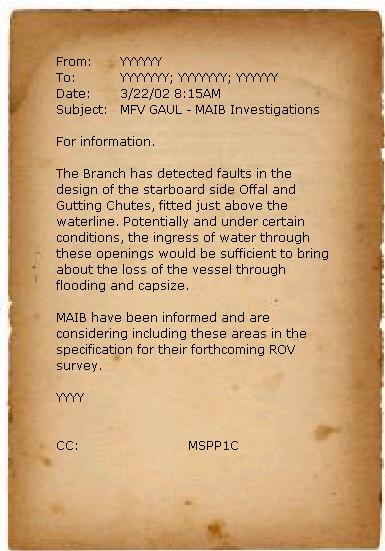
The above paragraph gives a gentle hint, from the Department, that the issues raised in the technical paper do not in fact constitute new evidence; so we will take this as our cue to publish a fragment from one of the items of correspondence, now in our possession, which can, perhaps, shed some light on this matter:
The fragment reproduced above indicates that, even before the RFI, a number of governmental experts, with recognised qualifications and experience, considered the design and construction of the duff and offal chutes on the Gaul to be a cause for concern and advised accordingly.
However, the DfT’s ambiguous reply presents us with an intriguing contradiction: if the design fault theory is not new evidence, then the DfT no longer needs to check it -this must have been already discussed in the past, and the reasons for its dismissal known and capable of being shared with the public.
Otherwise, now that we, together with the DfT, have finally come to the conclusion that this was not new evidence, should we not wonder whether a miscarriage of justice might have occurred?

Monday, September 25, 2006

Reprisals

The research into the outcome of the Gaul formal inquiry was carried out by a naval architect who is currently employed by the UK government (i.e. The Maritime and Coastguard Agency).
For some time now, he and his family have been subjected to close monitoring and various acts of intimidation.
It is, of course, regrettable that a challenge to the results of this inquiry could have serious implications for those directly involved in the case, but, considering also the implications of leaving things as they are, such regrets cannot be a good enough reason for remaining silent.