Showing posts with label standards. Show all posts

Friday, August 23, 2013

Weighty Matters

During the past 40 years, the Department for Transport (DfT) has gained a wealth of experience in the art of data manipulation and disinformation when conducting official investigations into fishing vessel casualties, especially those in which dubious stability was thought to be a factor in their loss. This expertise is currently being used quite blatantly by the DfT (via MAIB) to both cover their own backs and safeguard the interests of their many business ‘clients’.

Generally, the DfT only feels threatened when it has made a mistake - when there is something it did not do, that it should have done or it did something that it should not have done - and lives were subsequently lost at sea.

In the case of the FV Gaul, the DfT approved her stability (see copy of the stability certificate below), for unlimited operation at sea, just 14 month’s before the trawler capsized and sank (in February 1974), with the loss of 36 lives.


Following the loss of the Gaul, the official investigation, led by the DfT, was quick to put on record that the Gaul had met the IMCO minimum stability standards for deep-sea trawlers “with a substantial margin”. 

In our posts of 1 January 2010 [LINK] and 8 February 2010 [LINK] we were able to point out that this official statement was, in fact, incorrect and we gave details of the Gaul’s ‘arrival in Port’ and preceding sailing conditions where the IMCO minimum stability standards were not and could not be met. 

Trident 
 
In our post of 4 August 2010 [LINK] we also described how the stability records for the calculated lightship and sailing conditions of the Trident, which capsized and sank in 1974, with the loss of 7 lives, were callously modified by the Trident RFI experts (hired and paid for by the DfT) to give credence to the “official” view that, at the time of her loss, the Trident substantially met the IMCO stability standards of the day – an official requirement for grant-aided fishing vessel purchases in the early 1970s. 

We also noted in our posts of 28th February [LINK] and 27th April 2011 [LINK] that considerable sums of money had been squandered on worthless model tests, which were deliberately fed with doctored data, to give the results that our officials desired [1]

This blatant deception was only attempted because, contrary to official policies, the Trident’s lightship particulars (and stability reserves) had not been accurately established and verified [2] at the time that she was built. 

Gaul 

The Gaul’s lightship particulars (and stability reserves) were also left unverified when she was built [3], the data used being merely a copy of those derived from the inclining experiment, held in February 1972, on the Ranger Calliope (subsequently re-named Arab).

Testimony by Mr M. Scott (DfT surveyor) - 1974 Formal investigation into the loss of the Gaul - Day 12 page 27 : 


Surprisingly, if you check out the lightweight figures in the footnote below [4] you can see that an additional 11 tons of solid ballast has somehow managed to make its way into the calculations of the DfT, the shipyard and the Owner’s Consultants. When their investigations into Gaul’s stability were put in hand for the 1974 inquiry, it became an integral, unspecified part of the Gaul’s lightship weight. 

This 11 tons of notional ballast was useful in subsequent calculations in that it lowered the Gaul’s vertical centre of gravity (by 180 mm) - and would therefore be readily adopted by those who did not wish the tag of ‘deficient stability’ to be linked to the Gaul’s loss. Nonetheless, at the original FI hearings, the Builders, Brooke Marine, the Owner’s consultants, Y-ard and the DfT all managed to imply that solid ballast was not necessary on the Gaul to meet the IMCO minimum stability requirements (see below):

Mr M. Scott (DfT) - transcripts day 12 page 45 

Mr G. Donaldson (Brooke Marine) transcripts day 9 page 67
 
Mr A. Gilfillan (Y-ard) transcripts day 11 page 43 – in proposing improvements for Gaul’s 3 remaining sister vessels: 


This notional ballast was also an integral but invisible part of the Gaul’s lightship weight during the subsequent lengthy and expensive testing carried out by Morral in the late 1970s at the National Maritime Institute. This was another instance in which taxpayer’s money was spent on extensive model testing, but in which the basic data was skewed, to give the results that our officials desired. 

If we exclude this 11 tons of phantom ballast (it was not present on the Gaul) from the Gaul’s lightship and then check out her reserves of stability, we can see that this was degraded to the point where she did not meet the IMCO minimum stability criteria on arrival at distant fishing grounds. Furthermore, if she then did not proceed to promptly fill her fish hold with a significant catch of fish, she would be unable to meet the IMCO minimum stability standard throughout the rest of her voyage!

_______________________________________________________

[1] In 2005 the DfT also deliberately destroyed a number of folders of evidence and video that was unfavourable to their desired outcome.

[2] Neither an inclining experiment nor lightship check was carried out on the Trident. 

[3] The Gaul’s lightship data (displacement & vertical and longitudinal centres of gravity) were not obtained from a unique inclining experiment; they were copied instead from an inclining experiment held on the Ranger Calliope (a sister to the Gaul) on 1 February 1972; however, a simple lightweight check, to verify the integrity of the copied data, was not carried out on the Gaul. 

[4] Lightship data obtained from the inclining test on the Ranger Calliope
Displacement = 1099.63 tons, 
Vertical centre of gravity = 20.2 ft above base 
Longitudinal centre of gravity = 9.46 ft aft Midships 
Gaul Lightship data - used for all official stability investigations: 
Displacement = 1110.6 tons, 
Vertical centre of gravity = 20.02 ft above base 
Longitudinal centre of gravity = 9.99 ft aft Midships

Saturday, July 23, 2011

Stability standards for scallop dredgers - Solway Harvester and Olivia Jean

On 10 October 2009, a crewmember onboard the scallop dredger Olivia Jean was injured when a trawl wire parted and he was hit by a falling bridle. The fisherman sustained chest injuries and was subsequently airlifted to hospital

Following that accident the MAIB carried out a detailed safety audit onboard the Olivia Jean and a number of regulatory non-compliances, including stability deficiencies, were identified,

The Maritime and Coastguard Agency (MCA) were notified and they also inspected the vessel; however, they subsequently permitted the Olivia Jean to continue fishing even though the official limits in her trim and stability book were regularly being exceeded [1].

As a consequence, the MAIB issued Safety Bulletin No 1/2010, which called on the Olivia Jean’s owner to cease fishing operations immediately and on the MCA to:
Ensure that the stability of Olivia Jean (TN 35) is verified and all safety critical limitations are applied before allowing further fishing operations to take place

The release of this safety bulletin, critical of MCA, was an unusual action for the MAIB to take as generally both MAIB and MCA worked together and supported one another (both being part of the maritime section of the Department for Transport).

Perhaps the MAIB were remembering previous scallop dredger losses – the Pescado in 1991 (where six men died) and the Solway Harvester in 2000 (where seven men died) and were concerned that stability deficiencies on yet another scallop dredger could lead to another tragedy.

The MAIB would also have been mindful of the fact that in 2006 when they had published the Solway Harvester report they had been obliged, once again [2], to tidy up a mess left for them by MCA, which they did by skipping over the Solway Harvester’s stability deficiencies.

Stability Standards

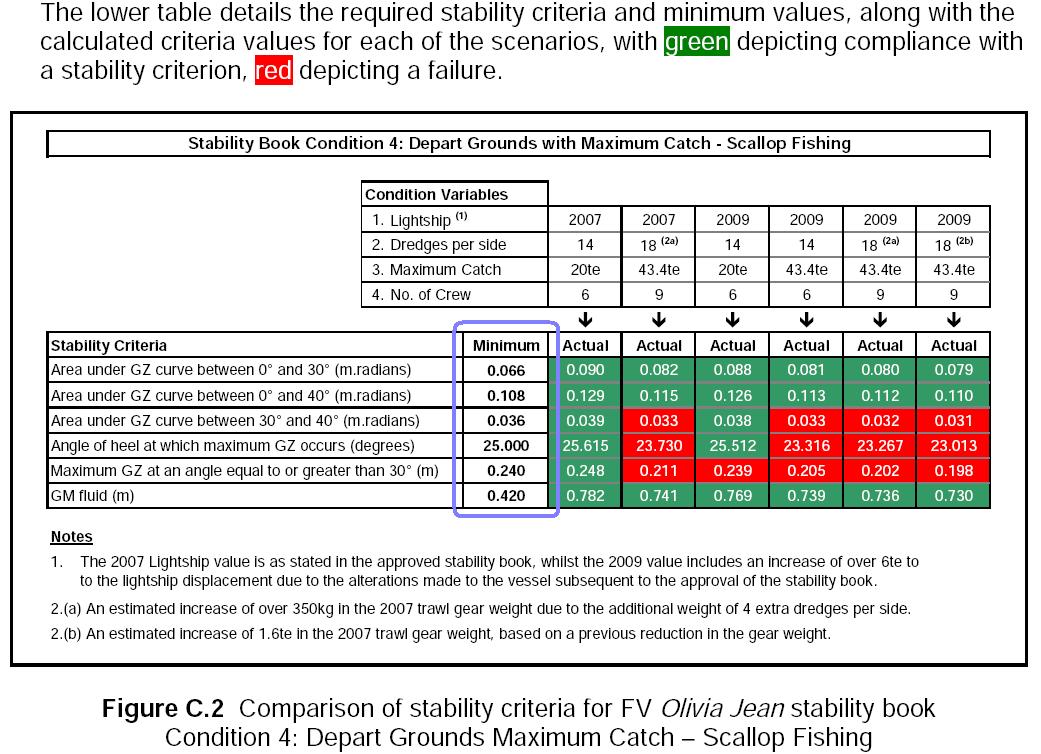
Extracts from the MAIB’s casualty reports for the Olivia Jean and the Solway Harvester are reproduced below, where the stability of each vessel has been assessed by MAIB for compliance with minimum stability standards.

Olivia Jean


MAIB’s stability assessment - they compared Olivia Jean’s actual stability reserves against the official stability minima (ringed in purple); these minimum criteria include the 20% stability enhancement that is required for scallop dredgers. In the example shown here, the Olivia Jean fails to meet the required stability standard in the ‘depart grounds’ sailing condition.

Solway Harvester – stability curve for the loss condition

The Solway Harvester’s marginal stability reserves and poor GZ values are clearly visible from this curve:


MAIB’s stability assessment – they compared the Solway Harvester’s estimated stability reserves against the minimum stability criteria ringed in purple above; however, these minimum stability criteria, chosen by the MAIB for comparison purposes, are different from the criteria they used for the Olivia Jean – they are the wrong criteria as they do not include the 20% stability enhancement that is required for scallop dredgers and beam trawlers. However, by comparing the Solway Harvester’s stability values against a lower stability standard, the MAIB were able to say that she ‘passed’ the requirements (the figures reveal a marginal pass of the lesser stability standard).

The MAIB were aware that they were on shaky ground here and, when they published their report on the Solway Harvester’s loss, the important part within their report - where the minimum stability criteria were identified - was barely legible as well as very carefully worded.

They talk about “compliance with regulations”, yet they do not identify which specific regulations the vessel allegedly ‘passed’.
It certainly didn’t meet the regulations applicable to scallop dredgers (i.e. Rule 16 of the Fishing Vessels Safety Provisions Rules 1975 with the 20% increase in stability for fishing vessels engaged in twin boom fishing).

Moreover, it is also highly likely that, given the number of questionable assumptions made by the MAIB in their calculations for the Solway Harvester’s loss condition, she did not even comply with the lesser stability standards either.

Solway Harvester

In the above image (c/o STV website), the Solway Harvester can be seen sailing in a deeply laden condition where her freeboard and stability reserves are clearly suspect. In the above image, the blue arrow indicates the position of her watertight main deck – only just above the sea-surface.

It should be noted that Solway Harvester’s design allowed seawater to freely enter the non-weathertight steel enclosures and wash across her decks.

If, as shown in the sketch below, the non-weathertight enclosures are removed, the watertight hull and three-weathertight superstructures become apparent. The main deck is only just above the sea-surface (arrowed) and thus, when the above photo was taken, the only things keeping the vessel afloat and upright at that time were the meagre buoyancy reserves provided by the small part of her hull above seawater and the three small superstructures.

MAIB report no. 1/2006

Concluding remarks

If, on 11 January 2000, the Solway Harvester had complied fully with official stability standards it is just possible that, she would not have succumbed to the weather and capsized with the loss of all onboard.

---------------------------------------------------------------
[1] The MCA have sole responsibility for statutory surveys, stability approval and the issue of fishing vessel safety certification on UK fishing vessels.
[2] The MAIB have had to investigate and report on a number of fishing vessel casualties where the MCA’s ‘light regulatory touch’ has been an obvious factor in the loss.

Sunday, February 27, 2011

FV Trident RFI - “No evidence was led at the inquiry…”


Perhaps the most important question for the RFI, once it had established that the Trident had capsized in sea conditions that were not exceptional and that her intact stability was deficient, was whether full compliance with the IMCO minimum stability standard would have prevented Trident’s capsize and the loss of seven lives.

Unfortunately, this was one critical question that the RFI's investigators were unwilling to answer. They were prepared to answer questions that skirted this central issue, they also touched upon matters on the fringes of this issue and were happy to pontificate at great length about many things that seemed to be related, but in fact deflected attention elsewhere.

Perhaps the nearest we can get to a straight answer on this important point is contained within the Sheriff's comments in Para [41] of his final report:

The first question here is what changes would have had to have been made to the design and construction of the Trident to secure full compliance with the IMCO recommended criteria when she was built. No evidence was led at the inquiry, which would allow me to answer this question, so it is impossible to hold that, if she had been built so as to secure full compliance with these criteria, she would not have been lost.

But surely, Your Honour, as you were in charge of this £7m inquiry, you should have given directions that evidence be obtained and led on this matter?

You were eager to dismiss the results of the 1976 NMI model tests, the report from which, co-incidentally, showed that Trident would have survived if the IMCO Stability criteria had been met. In the words of Dr A. Morrall:

Experiments in breaking waves were repeated and no capsize was obtained. Test periods of up to 1 hour full scale were carried out. Motions were extremely severe and decks were very wet and an impression was gained that limiting conditions for survival had been reached.

Instead we have been asked to accept the conclusions that were drawn by a panel of experts, whose objectivity can be disputed, from a very limited and questionable set of test results from the MARIN test facility in Holland.

Question

Why was the Trident model NOT tested at the MARIN test facility in a condition representing full IMCO compliance so as to see whether or not she would capsize?

If tests had been carried out in this condition, then we would have had a straightforward and conclusive answer to the main question above.

This would not have been a difficult or expensive test to arrange, and it would have provided concrete evidence for the RFI. In fact, when a similar test was carried out at the NMI test facility in 1976 Dr Morrall commented: "this was achieved quite easily by rearranging the ballast inside the model and carrying out an inclining experiment to check"

Perhaps we already know the reasons why evidence was not sought or allowed on this point. The OAG, DfT, Seafish and a number of other parties just did not want to hear the answer that:

If Trident had met the IMCO minimum stability standard, she would have survived.

More to come…….

Saturday, February 26, 2011

FV Trident RFI - The development risks defence [*]


In earlier posts, concerning the Derbyshire and the Gaul disasters [http://mv-derbyshire.blogspot.com/2008/10/dry-run-for-litigation.html], we have highlighted the fact that formal investigations into maritime casualties are mainly driven, not by a desire to seek out the truth of the matter, but by the over-arching principle that any form of litigation ,which could be harmful to Government or the British Establishment, must be avoided at all costs.

We have now seen that, throughout the Trident RFI, this principle has remained the primary driver of events.

An example of this can be seen in Question 5, posed by the AG: 
5. At the commencement of her last voyage was the Trident unseaworthy (as determined by the standards which applied in 1974)…

This question enabled the Sheriff to give a ruling, which would support the ‘development risks defence’ argument, in any future product liability case, where compensation was sought.

His response, in paragraph [49], states:

What happened to the Trident on the day of her loss was not reasonably foreseeable to anyone in light of the knowledge and understanding of the design and construction of seagoing vessels available at the time.

While the clear intention of the Sheriff’s statement is to support any future ‘development risks defence’ argument, the statement in itself is clearly nonsense. In 1974, fishing vessel capsizes were an all too frequent occurrence and what happened to the Trident was, in fact, foreseeable; that is why, at that time in the UK, there was a requirement for fishing vessels to be designed and constructed to meet the IMCO minimum stability standard.

It is our belief that public inquiries should be about seeking the truth, not about providing cover for potential defendants.

---------------------------------------------------------------

[*] http://www.jstor.org/pss/4507206

Wednesday, February 23, 2011

The Trident and Aquila inquiries ... and interesting facts about scallopers


We think that we may have found one of the reasons for the delay in finalising the Trident’s RFI report: the DfT is keeping Mr Macwhirter, the Assessor in the Trident inquiry, very busy these days, as he is also giving evidence, in his role as stability expert for the MAIB, in the Fatal Accident inquiry into the Aquila tragedy. (See press article HERE)

Mercifully, the experts in that inquiry have not seen the need to delve too deeply into vessel motions and dynamic stability topics, and appear to be ready to arrive at their conclusions concerning the loss of the Aquila by reference to contemporary stability standards only.

That being said, we must admit to being somewhat surprised to learn from the Press and Journal article that Mr Macwhirter considered the “extra weight alterations to the Aquila over the years were unlikely to have caused the capsize”, as he had also previously stated that the extra weight on the Aquila had led to a significant deterioration in her intact stability [1] reserves.

So, we thought we would check his further views in the MAIB’s ‘Aquila’ report:

9. Conclusions:
Further analysis indicated that even if the Aquila had fully complied with the stability requirements, it was very probable that capsize would still have occurred [2]

At first glance, this statement appeared quite familiar to us once we realised that, if we substituted ‘Trident’ for ‘Aquila’ in the above sentence, then this would be exactly the same conclusion that the experts in the Trident RFI are striving to arrive at!

There is a striking level of consistency here!!!

And, if we think about this some more, it looks like we are being invited to believe that official ‘stability standards’ have little value when it comes to preventing capsizes of Scottish fishing vessels.

We would take a contrary view and suggest that, apart from being nonsense, this is not really the type of message that a responsible Maritime Authority (like the DfT) should be promoting.

---------------------------------------------------------------

[1] And thus be more likely to capsize

[2] Unfortunately the “stability requirements” that Mr Macwhirter used as the basis for his analysis were for side and stern trawlers only, not for scallop dredgers (as the Aquila was). Scallopers are required to meet an enhanced stability standard (i.e. trawler stability standards increased by 20%). Now if the Aquila had indeed met the scalloper stability standard ….what would his conclusions have been regarding her probability to capsize?

Monday, July 05, 2010

FV Trident - Centres of gravity

During the Original Formal Investigation (OFI - 1975) into the loss of the fishing vessel Trident, matters pertaining to her stability were examined in great depth; however, when it came to writing the final report of the investigation, the Court felt unable to make a pronouncement on whether the Trident had met IMCO’s minimum stability standards or not:

It is impossible to assert categorically that Trident did or did not comply with the IMCO recommendations, to which it was intended that she should be built

Apart from the uncertainty arising from the absence of an inclining experiment, one of the principal reasons cited for this unfortunate lack of assurance was the fact that there were known discrepancies between the designer’s original drawings and the as-built hull shape of the Trident and her sister vessel, the Silver Lining.

In the OFI’s final report, this point was emphasised by including two stability calculations as an Annex, one based upon the dimensions taken from the designer’s drawings (Bute lines) and one based upon the dimensions lifted from her sister vessel, the Silver Lining (Napier lines).

These two sets of stability calculations show that the Trident’s stability passed the IMCO recommendations when the calculations were carried out based upon the ‘Bute lines’ dimensions, but failed the IMCO recommendations when the same calculations were carried out based upon the ‘Napier Lines’ dimensions:

Partial copies from OFI final report plus amendments

This all seems to be quite straightforward and, apparently, justifies the Court’s uncertainty on this matter.

However, what is not immediately apparent, both from the 1976 OFI report and from the transcripts of Court evidence, is the fact that the real reason why the Bute hulled version of Trident ‘passed’ and the Napier hulled version of Trident ‘failed’ was that the vertical centres of gravity (VCG) that were used for these two separate stability calculations were different:
  • Bute hull lightship VCG = 10.072 feet above the keel (a value of unspecified provenance)
  • Napier hull lightship VCG = 10.487 feet above the keel (value derived from the inclining experiment carried out on Silver Lining and subsequently used in the 1976 NMI research)
If the same vertical centre of gravity figures had been used in both of these two stability calculations, they would have indicated either a double failure (when the VCGs = 10.487 ft) or a double pass (when the VCGs = 10.072 ft)
i.e The Trident’s stability calculations would show a pass or a fail (with respect to the IMCO stability standard) dependent upon the value of VCG used and not, as the OFI implied, due to differences between the Bute and Napier hull geometries, which were not, by themselves, sufficient to influence the results of the stability calculations.

What is more, it would appear that this was not just an oversight, but more of a deliberate ‘smoke and mirrors’ exercise by the DOT who, when they drafted conditions A1 and A2, also forgot to include the lightship VCG figures in the tables that are contained in the final OFI report:


If one reads through the transcripts of evidence for the 1975 inquiry, it is notable yet again [link to previous FV Gaul post] that Council for the DOT (who in 1975 carried out similar functions to those performed by the AG in the 2010 inquiry) was quite anxious to put forward the notion that Trident had complied substantially with the IMCO minimum standards.

(More to come)

Friday, January 01, 2010

The stability of the trawler Gaul

To bring in the New Year with a bang, we would like to announce the outcome of an independent, critical and detailed investigation into the operational stability reserves of the freezer trawler Gaul. The results of this investigation reveal that, contrary to the many official pronouncements that were made on this matter (in 1974, 1980, 1999 and 2004), the Gaul’s reserves of intact stability did not in fact meet the minimum standards and norms that were expected for a fishing vessel built in the early 1970s (ref. IMCO “Recommendation on Intact Stability of Fishing Vessels” 1968).
An extract from the final report of the Formal Investigation into the loss of the Gaul (1974) gives the first pronouncement on this matter:

When the stern-trawler Gaul and her crew left Hull at 6 AM on the morning of 22 January 1974 for the Barents Sea fishing grounds, they were not putting to sea in an “exceptionally seaworthy vessel” nor in one that “had excellent sea-keeping characteristics and a large range of intact stability” [1] as the hyperbole in the 1999 MAIB report into the loss of the Gaul would have us believe, instead they were setting out for a destination notorious for poor weather, in a ship, which did not meet the IMCO basic stability standards [2] in the sailing conditions that were normal for her service.
What made things worse, however, was the fact that due to a number of oversights and design errors, the official stability documentation that was provided onboard the Gaul for the use of the Skipper (although certified by the Department of Trade) over-estimated the vessel’s reserves of intact stability to such an extent that anyone using it would not have been able to identify when the vessel was approaching any marginal or critical stability conditions.
Added to that, and most important of all, was the fact that, shortly after her delivery, the Gaul’s owners converted two of her double bottom tanks to enable them to carry fuel oil instead of ballast water (ballast water was required on the Gaul to ensure that the vessel could maintain adequate stability in all anticipated sailing conditions), but the stability documents were not revised to take account of this significant modification.

The effects of this alteration could only be described as disastrous from the viewpoint of the Gaul’s ability to meet the IMCO stability standards (see example in Annex 1) and, in fact, on the day of her loss it is probable that, unbeknownst to her skipper, she was sailing in a marginal or deficient stability condition [3].

In 2004, the officials charged with conducting the Re-opened Formal Investigation into the loss of the Gaul managed to convince themselves, but not many others, that factory deck flooding, resulting from crew error was the reason why the Gaul had capsized and foundered.
Design faults, which could lead to such flooding, and the fact that the Gaul had inadequate stability for her proposed service were two critical issues that were kept strictly off the agenda.
-----------------------------------------------------------------
[1] MAIB - the Marine Accident Investigation Branch of the DfT
[2] The IMCO stability criteria have been recognized for more than forty years now as being the minimum base stability standard that should be met by seagoing trawlers to ensure safety at sea.
[3] From the viewpoint of stability assessment, the exact condition of the Gaul at the time of her loss cannot be accurately gauged and minor differences in assumptions made as to the amount of fish and gear onboard, fuel consumption, tank usage etc could take the vessel from a marginal ‘pass’ to a significant ‘fail’ (vis-à-vis the IMCO minimum standard).
---------------------------------------------------------------

The table above shows that the vessel fails to meet four of the IMCO’s six minimum stability criteria (i.e. the GZ areas and the initial GM value) in the given sailing condition and that the failure is neither marginal nor borderline, but a failure by a substantial margin (see differences between minimum stability criteria and the actual values). (Downloadable PDF version at http://freepdfhosting.com/7ecaf3651a.pdf)
Happy New Year!

Wednesday, November 25, 2009

FV Trident inquiry – confusion and instability

The Trident was a typical example of the Scottish trawlers that were built in the late 60’s and early 70’s of just less than 24.4m (80 ft) in registered length. Outwardly it exhibited no obvious characteristics or features that would set it apart from the other similar vessels built at that time.


This particular size and type of trawler had a proven reputation for being seaworthy in all weather conditions, and in this respect we would hope that, ultimately, the Court of inquiry will be able to identify those critical differences on Trident which set her apart from the rest of the Scottish fleet and which caused her to capsize and founder in relatively moderate sea conditions.
The Trident was only 18 months old at the time of her loss.

Stability

Judging by the latest press reports on the debate about Trident’s stability, it seems that currently, there is some confusion within the Court as to what ‘stability’ actually means in the context of a fishing trawler and on what stability standards should normally apply. There also seems to be some confusion as to how a fishing vessel’s stability is actually measured and assessed, and, additionally, the terms ‘static’ and ‘dynamic’ stability appear to have the Court’s official experts and Counsel talking at cross purposes.

In recent days it has been reported:

“Sheriff Principal Sir Stephen Young, who is overseeing the inquest, ordered him [the counsel for the families] to compile a second document restating his case.
The first order was served on Monday, when the court ruled that Mr Anderson’s arguments on static stability, dynamic stability and stability curves – all of which must be in check for a boat to remain upright – were not clear.” (Aberdeen Press and Journal 18 November 2009)

“The inquiry heard yesterday that an incline test on the Trident would not have revealed if she was at risk of capsizing.
Richard Anderson, representing some of the families, said it is their belief that the test, which is used to measure the stability of a boat in calm conditions, would have uncovered problems with the Trident’s stability.
William Boyd, a director of TMC Marine Consultants, told the inquiry the test “has no relevance” when a boat is out at sea.
[…] “An incline test is a necessary and useful test, but in predicting what external forces are going to arise at sea it has no relevance.” (Aberdeen Press and Journal 17 November 2009)

A MARINE expert insisted a test of a Peterhead-registered trawler which sank would not have proven whether it was sea-worthy. […] Mr Boyd said a test on the Trident would have been “non applicable” because it would have been carried out in calm waters. (Aberdeen Evening Express 17 November 2009)

“Master mariner Graeme Bowles said a static test on the boat would not have correctly assessed her stability when at sea, and that a dynamic stability test was usually done to check this. […] The inquiry had previously heard that an inclining test, usually done when the boat is static, had not been carried out. It examines the vertical centre of gravity and its effect on a vessel’s stability. […] When asked by Ailsa Wilson, QC for the advocate general, to explain the difference between static and dynamic tests, Mr Bowles said: 'Dynamic takes into account everything to do with the ship’s behaviour when she is at sea.' The test takes into account the risk of capsizing and the threat posed by violent winds and waves”. (Aberdeen Press and Journal 28 October 2009)

Perhaps we should consider the possibility that the personnel making up this ‘expert panel’ may not be wholly impartial, and that their ‘expert pronouncements’ and arguments, although developed at taxpayer’s expense, may be influenced, to some degree, by the specific interests of their clients.

Mr Bowles and Mr Boyd’s assertions, which have been quoted above, unless taken out of context, are incorrect and misleading; they don’t reflect the stability standards that are applied either on current UK fishing vessels or on those built in 1973. The two marine experts also play down the critical importance that an ‘inclining test’ has in determining a vessel’s stability.
Their implication that the International Maritime Organization’s mandatory requirements for inclining experiments and stability [1] were developed for purposes other than vessels operating at sea is really quite surprising.

Currently, inclining tests are an essential part of the statutory processes that ensure UK fishing vessels have adequate stability while operating at sea. (ref. Merchant Shipping Notice 1770 – contains mandatory static and dynamical stability criteria for contemporary fishing vessels of a type and size similar to Trident).

It may be useful, perhaps, to provide some clarification on the types of ‘stability’ that have been discussed during this inquiry:

All vessels have an inbuilt or inherent level of stability/resistance to capsize; however, this remains an ‘unknown quantity’ until an inclining test has been carried out. The inclining test enables the weight of the vessel and the position of its centre of gravity to be determined. It is only when these values are known that the elements of a vessel’s static and dynamical stability can be calculated and compared against the standards that are required to ensure safety at sea.

Stability (in ships) - is a measure of a ships ability to return to its upright position after being heeled through some angle to port or to starboard. The tendency of a ship to ‘right itself’ is caused by the horizontal separation of the ships weight and buoyancy forces when it is heeled. The term ‘stability’ has a distinct meaning for commercial seagoing vessels and its values may be calculated accurately for different sailing conditions. The principal stability standards that are applied in the UK today are those laid down by the International Maritime Organization in the form of static and dynamical stability criteria, all of which a vessel must meet before it can put to sea.
While the IMO criteria have been developed from ‘static’ rather than ‘dynamic’ considerations and do not explicitly take ship motions and sea conditions into account, they have been found, after many years of experience and feedback from the world’s seagoing fleets, to provide a base stability standard that will prevent a vessel from capsizing in all but the most severe of weather conditions.

Inclining experiment - An inclining experiment neither measures nor tests a vessel’s stability. The purpose of an inclining experiment is to provide data that will enable a vessel’s displacement (weight) and the position of its centre of gravity to be determined. The inclining test is ‘static’ in nature and must be carried out in flat, calm conditions with the vessel in equilibrium in order to obtain accurate results. The results from an inclining experiment are essential for the accurate determination of a vessel’s stability characteristics.

Static stability (righting moment) – For a ship, the static stability at any given heel angle is the product of the horizontal separation (called GZ) between the vertical lines of action of the ship’s buoyancy force and of its weight multiplied with its displacement (note these two lines of action pass through the ship’s centre of buoyancy and centre of gravity respectively). The value of GZ varies with the angle of heel, and, if this variation is plotted from 0 degrees to (say) 90 degrees, something called a curve of statical stability is obtained.

Dynamical stability – If the area under the curve of statical stability is calculated up to any particular angle or between two inclined angles then this is known as the dynamical stability for the vessel (for the range of inclinations considered). It is a measure of the work required to be done or energy expended when forcing the vessel to heel to that angle.

Dynamic stability – This is a term that currently has different meanings for different people within the maritime industry. Traditionally it has been used instead of the term ‘Dynamical stability’ and additionally it has been used to describe a vessel’s ‘directional stability’ (ref Rawson & Tupper – Basic Ship theory) but, nowadays, more often than not, it is used (or misused) in a generic sense to describe the various properties that a ship may exhibit when in motion in a seaway.
Recently, as a result of concerns on stability fluctuations on large vessels such as Container or passenger ships the IMO has decided to examine ‘Dynamic stability phenomena in waves’ with a view to the eventual development of agreed mandatory criteria. However, this is a complex matter and it will be a number of years before any new stability criteria emerge.

******

It is obvious from the above that there is some scope for confusion between the terms ‘dynamical stability’ and ‘dynamic stability’ and, just as has happened in maritime circles, the Court may also have fallen victim to this misunderstanding.
Perhaps the differences between the two opposing camps and their views on stability could be briefly summarized as follows:

  • The Counsel for the families would very much like the investigation to focus upon the types of trawler ‘stability’ that can be accurately calculated following an inclining experiment and for which there are International and National standards laid down (criteria for static and dynamical stability) i.e. something which is tangible.
  • It would appear that Counsel for the other parties (including the Advocate General) might prefer the investigation to consider ‘dynamic stability’, for which no industry standards have been yet agreed either Internationally or Nationally and which has different meanings for different people: i.e. something which, at this moment in time, is not tangible.

In its latest revision to the International Code on Intact Stability, 2008 the International Maritime Organisation had this to say regarding the stability of ships in a seaway:

“The safety of a ship in a seaway involves complex hydrodynamic phenomena which up to now have not been fully investigated and understood. Motion of ships in a seaway should be treated as a dynamical system and relationships between ship and environmental conditions like wave and wind excitations are recognized as extremely important elements. Based on hydrodynamic aspects and stability analysis of a ship in a seaway, stability criteria development poses complex problems that require further research.”

It is suggested that while ‘Dynamic Stability’ may currently be of great interest to researchers, designers and operators of large container and cruise vessels, it is inappropriate for this developing field of applied science, on which there is no consensus, to be used as a basis for legal argument in a court of inquiry into the loss of a small trawler.
----------------------------------------------------------
[1] IMO - International Code on Intact Stability

Sunday, January 04, 2009

More about MV Derbyshire

This is to wish you all a Happy New Year and to let you know that we have just published a new post on the MV Derbyshire blog [1].
In this latest commentary we show that the hatch covers on the Derbyshire complied neither with the minimum strength requirements of the International Load Line Convention 66 nor with the standards of Lloyd’s Register of Shipping that were in force at the time of the vessel’s build. These non-compliances, which could have been a crucial factor in the loss of the vessel, were ‘overlooked’ during 2000 RFI, the final report of which stated: “7.16 At the time of the DERBYSHIRE’s last voyage her hatch covers complied with the minimum strength requirements of ILLC 66 and of the Lloyd’s Register of Shipping Rules”, and concluded that it was a severe deficiency within those standards that allowed the vessel’s hatch covers to be built with inadequate strength, thus making their failure and the subsequent loss of the vessel in heavy seas possible.
However, independent strength calculations (presented in detail on the MV Derbyshire blog), carried out both through classical methods and by means of finite element analysis, show that the strength of the hatch covers fell short even of the minimum requirements that were set in those “deficient” 1966 standards.
Whether or not the vessel would have been lost if the construction of the hatch covers had conformed to the rules applicable at that time - insufficient as they were - is, furthermore, debateable. Placing the blame on the ‘regulations’, however, as the 2000 RFI so kindly did, made further debate redundant and removed the risk of subsequent commercial litigation for the vessel’s Shipbuilders and the Classification Society.
----------------------------------------------------

[1] The Derbyshire Re-opened Formal Investigation bears many similarities with the Gaul Re-opened Formal Investigation – not the least of which is the fact that both investigations were presided over by judges who were acknowledged experts in the field of maritime commercial litigation.
Why was it that these two public inquiries, supposedly aimed only at finding the truth, were set up in this way?

Friday, September 15, 2006

The "Accidents and Agenda" report published by the Royal Academy of Engineering in 2005 explores the ways in which the processes of accident investigation may be improved with the aim of preventing the occurrence of similar incidents in the future.